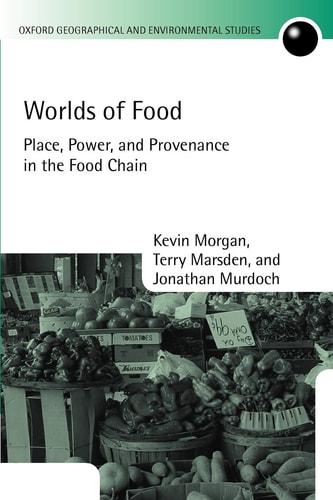
Worlds of Food: Place, Power, and Provenance in the Food Chain
0
0
As an Amazon Associate and affiliate partner, Menrva Books earns from qualifying purchases. Learn more
Author Description
From farm to fork, the conventional food chain is under enormous pressure to respond to a whole series of new challenges - food scares in rich countries, food security concerns in poor countries, and a burgeoning problem of obesity in all countries. As more and more people demand to know where their food comes from, and how it is produced, issues of place, power, and provenance assume increasing significance for producers, consumers, and regulators, challenging the corporate forces that shape the 'placeless foodscape'. Far from being confined to niche products, questions about the origins of food are also surfacing in the conventional sector, where labelling has become a major political issue.Drawing on theories of multi-level governance, three leading scholars in the field explore the geo-politics of the food chain in different spatial arenas: the World Trade Organization, where free trade principles clash with fair trade concerns in the debate about agricultural reform; the European Union, where producers are under pressure from environmentalists for a more traceable and sustainable food system; and the US, where there is a striking contradiction between the rhetoric of free markets and the reality of a heavily subsidised farming sector. To understand the local impact of these global trends, the authors explore three different regional worlds of food: the traditional world of localised quality in Tuscany, the peripheral world of commodity production in Wales, and the frontier world of agri-business in California.
Menrva's Summary
THE THESIS
This book investigates how the modern food chain navigates the competing pressures of global trade, local provenance, and corporate power. The authors, Jonathan Murdoch, Kevin Morgan, and Terry Marsden, utilize theories of multi-level governance to analyze the geopolitical tensions inherent in food production. By examining the friction between free-market rhetoric and regulatory reality, the text argues that the origins and spatial identity of food have become central political concerns for producers and consumers alike.
THE SCOPE MAP
What You Will Find
- Analysis of multi-level governance in the World Trade Organization, European Union, and the United States.
- Comparative regional case studies focusing on Tuscany, Wales, and California.
- Examination of the conflict between corporate 'placeless' foodscapes and localized quality production.
- Discussion of food security, sustainability, and the political implications of food labeling.
THE AUTHORITY PERSPECTIVE
Experts recognize this work as a foundational text for understanding the intersection of geography and agricultural policy. Readers frequently note the academic density of the prose and its utility in mapping the complex power dynamics of the global food chain.
Page Count:
256
Publication Date:
2009-09-28
Publisher:
Oxford University Press
ISBN-10:
0199542287
ISBN-13:
9780199542284
Economics
Food supply
Food Industry
Earth Sciences
Geography
Agriculture
Sociology
Community Tags
Similar Books