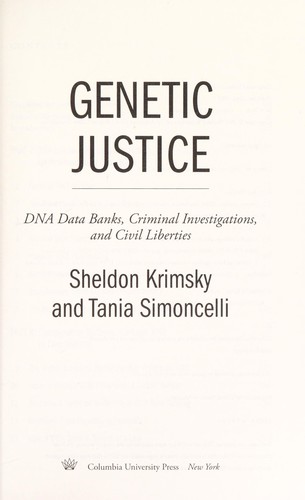
Genetic Justice
0
0
As an Amazon Associate and affiliate partner, Menrva Books earns from qualifying purchases. Learn more
Author Description
National DNA databanks were initially established to catalogue the identities of violent criminals and sex offenders. However, since the mid-1990s, forensic DNA databanks have in some cases expanded to include people merely arrested, regardless of whether they've been charged or convicted of a crime. The public is largely unaware of these changes and the advances that biotechnology and forensic DNA science have made possible. Yet many citizens are beginning to realize that the unfettered collection of DNA profiles might compromise our basic freedoms and rights. Two leading authors on medical ethics, science policy, and civil liberties take a hard look at how the United States has balanced the use of DNA technology, particularly the use of DNA databanks in criminal justice, with the privacy rights of its citizenry. Krimsky and Simoncelli analyze the constitutional, ethical, and sociopolitical implications of expanded DNA collection in the United States and compare these findings to trends in the United Kingdom, Japan, Australia, Germany, and Italy. They explore many controversial topics, including the legal precedent for taking DNA from juveniles, the search for possible family members of suspects in DNA databases, the launch of "DNA dragnets" among local populations, and the warrantless acquisition by police of so-called abandoned DNA in the search for suspects. Most intriguing, Krimsky and Simoncelli explode the myth that DNA profiling is infallible, which has profound implications for criminal justice.
Menrva's Summary
THE THESIS
The expansion of national DNA databanks from convicted criminals to include arrestees raises profound questions about the balance between public safety and individual privacy. Sheldon Krimsky and Simoncelli, experts in medical ethics and civil liberties, examine the ethical, constitutional, and sociopolitical ramifications of this shift in the United States, drawing comparisons with international trends in the UK, Japan, Australia, Germany, and Italy. They investigate controversial practices such as DNA collection from juveniles, familial searching, DNA dragnets, and the acquisition of abandoned DNA, while also debunking the myth of DNA profiling infallibility, which has significant implications for the criminal justice system.
THE SCOPE MAP
- Analysis of the expansion of forensic DNA databanks beyond convicted offenders to include arrestees.
- Exploration of constitutional, ethical, and sociopolitical implications in the United States.
- Comparative study of DNA databank trends in the United Kingdom, Japan, Australia, Germany, and Italy.
- Discussion of controversial topics including DNA collection from juveniles and familial searching.
- Examination of 'DNA dragnets' and the acquisition of abandoned DNA.
- Debunking the myth of DNA profiling infallibility and its impact on criminal justice.
- Consideration of the public's awareness of changes in DNA collection practices.
THE AUTHORITY PERSPECTIVE
This book critically examines the evolving landscape of DNA databanks and their impact on civil liberties, drawing on extensive research and comparative analysis. The authors delve into complex ethical and legal questions surrounding expanded DNA collection, challenging common assumptions about the technology's infallibility. The work is positioned as an essential read for understanding the societal implications of advancements in forensic science and their intersection with privacy rights. It aims to inform both policymakers and the public about the delicate balance required to uphold justice without compromising fundamental freedoms.
Page Count:
406
Publication Date:
2011-01-01
ISBN-10:
0231145209
ISBN-13:
9780231145206
Politics
True Crime
Non-Fiction
Science
Bioethics
Forensic Science
Community Tags
Similar Books