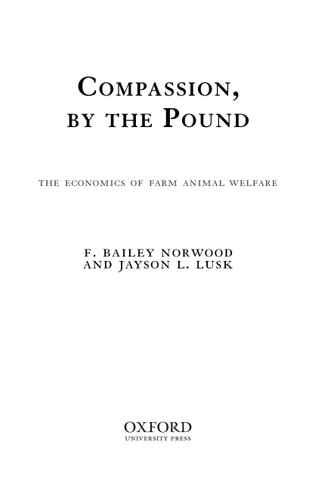
Compassion, by the Pound: The Economics of Farm Animal Welfare
0
0
As an Amazon Associate and affiliate partner, Menrva Books earns from qualifying purchases. Learn more
Author Description
For much of human history, most of the population lived and worked on farms but today, information about livestock is more likely to come from children's books than hands-on experience. When romanticized notions of an agrarian lifestyle meet with the realities of the modern industrial farm, the result is often a plea for a return to antiquated production methods. The result is a brewing controversy between animal activist groups, farmers, and consumers that is currently being played out in ballot boxes, courtrooms, and in the grocery store. Where is one to turn for advice when deciding whether to pay double the price for cage-free eggs, or in determining how to vote on ballot initiates seeking to ban practices such as the use of gestation crates in pork production or battery cage egg production? At present, there is no clear answer. What is missing from the animal welfare debate is an objective approach that can integrate the writings of biologists and philosophers, while providing a sound and logical basis for determining the consequences of farm animal welfare policies. What is missing in the debate? Economics.This book journeys from the earliest days of animal domestication to modern industrial farms. Delving into questions of ethics and animal sentience, the authors use data from ingenious consumers' experiments conducted with real food, real money, and real animals to compare the costs and benefits of improving animal care. They show how the economic approach to animal welfare raises new questions and ethical conundrums, as well as providing unique and counter-intuitive results.
Menrva's Summary
THE THESIS
This book investigates how economic analysis can provide an objective, logical framework for resolving the complex and often polarized debate surrounding farm animal welfare policies. The authors, F. Bailey Norwood and Jayson L. Lusk, utilize their expertise in agricultural economics to bridge the gap between biological research, philosophical ethics, and consumer behavior. By applying economic principles to the realities of modern industrial farming, they argue that policy decisions regarding livestock treatment require a rigorous evaluation of costs, benefits, and trade-offs that are currently absent from public discourse.
THE SCOPE MAP
What You Will Find
- Historical overview of animal domestication and the evolution of modern industrial farming practices.
- Economic methodology for evaluating the costs and benefits of various animal welfare improvements.
- Analysis of consumer behavior experiments involving real-world purchasing decisions and animal welfare preferences.
- Ethical frameworks for assessing the consequences of legislative actions like gestation crate bans and cage-free mandates.
THE AUTHORITY PERSPECTIVE
Experts and readers recognize this text as a unique contribution to the animal welfare debate by shifting the focus from purely emotional arguments to empirical economic analysis. The prose is noted for its accessibility, making complex agricultural and economic concepts understandable for both policymakers and the general public.
Page Count:
432
Publication Date:
2011-06-09
Publisher:
Oxford University Press
ISBN-10:
0199551162
ISBN-13:
9780199551163
Economics
Public Policy
Sociology
Livestock
Animal Welfare
Agriculture
Ethics
Community Tags
Similar Books