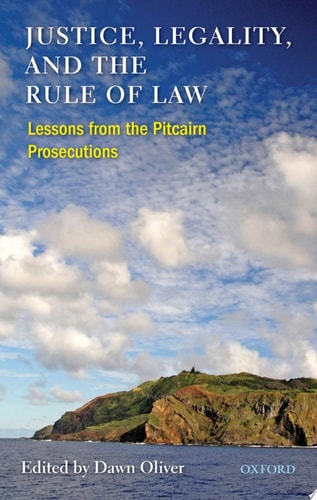
Justice, Legality and the Rule of Law: Lessons from the Pitcairn Prosecutions
0
0
As an Amazon Associate and affiliate partner, Menrva Books earns from qualifying purchases. Learn more
Author Description
A British colony of fifty souls in the Pacific Ocean, Pitcairn Island was settled by the Bounty mutineers and nineteen Polynesians in 1790. In 2004 six Pitcairn men were convicted of numerous offenses against girls and young women, committed over a thirty year period, in what appears to have been a culture of sexual abuse on the island.This case has raised many questions: what right did the British government have to initiate these prosecutions? Was it fair to prosecute the defendants, given that no laws had been published on the island? Indeed, what, if any, law was there on this island? This collection of essays explores the many important issues raised by the case and by the situation of a small, isolated community of this kind.It starts by looking at the background to the prosecutions, considering the dilemma that faced the British government when the abuse was uncovered, and discussing the ways in which the judges dealt with the case, as well as exploring the history of the settlement and how colonial law affects it.This background paves the way for an exploration of the philosophical, jurisprudential and ethical issues raised by the prosecutions: was it legitimate for the UK to intervene, given the absence of any common community between the UK and the Island? Was the positivist 'law on paper' approach adopted by the British government and the courts was appropriate, especially given the lack of promulgation of the laws under which the men were prosecuted? Would alternative responses such as payment of compensation to the female victims and provision of community support have been preferable? And should universal human rights claims justify the prosecutions, overriding any allegations of cultural relativism on the part of the UK?
Menrva's Summary
THE THESIS
This collection of essays investigates the complex legal and ethical legitimacy of the British government's intervention in the 2004 Pitcairn Island sexual abuse prosecutions. Dawn H. Oliver, a distinguished legal scholar, compiles expert analysis to examine the tension between colonial authority, the rule of law, and the protection of human rights in isolated communities. The text evaluates whether the application of UK law in a territory lacking formal legal promulgation constitutes a valid exercise of justice or an overreach of power.
THE SCOPE MAP
What You Will Find
- Historical analysis of the Pitcairn Island settlement and its unique colonial legal status.
- Jurisprudential debate regarding positivist legal theory versus cultural relativism.
- Examination of the British government's decision-making process during the investigation and trial.
- Ethical assessment of alternative justice models, including community support and victim compensation.
THE AUTHORITY PERSPECTIVE
Legal scholars and historians identify this work as a critical examination of the intersection between international human rights obligations and local sovereignty. Readers frequently note the academic density of the prose, which provides a rigorous framework for understanding the challenges of applying metropolitan law to remote, insular populations.
Page Count:
336
Publication Date:
2009-11-09
Publisher:
Oxford University Press
ISBN-10:
0199568669
ISBN-13:
9780199568666
Law
Jurisprudence
Human rights
Legal History
Ethics
Great Britain
Rule Of Law
Colonialism
Community Tags
Similar Books