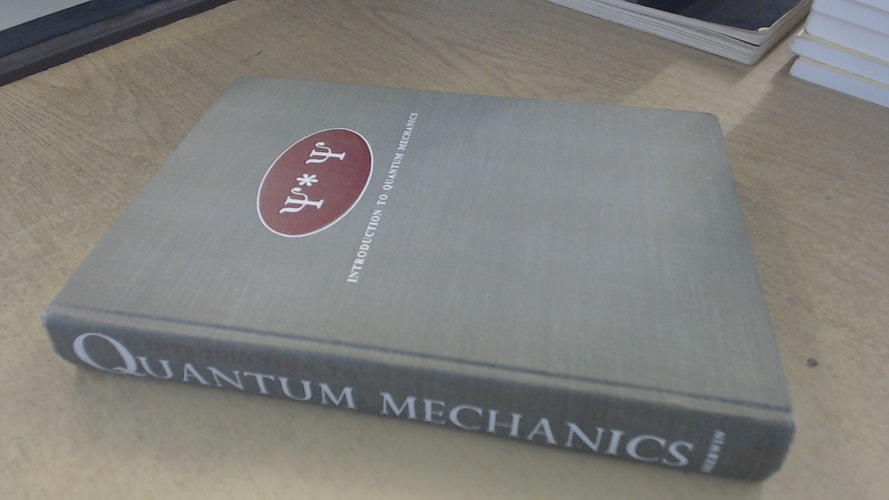
Introduction to Quantum Mechanics
0
0
As an Amazon Associate and affiliate partner, Menrva Books earns from qualifying purchases. Learn more
Author Description
This work has been selected by scholars as being culturally important, and is part of the knowledge base of civilization as we know it. This work was reproduced from the original artifact, and remains as true to the original work as possible. Therefore, you will see the original copyright references, library stamps (as most of these works have been housed in our most important libraries around the world), and other notations in the work. This work is in the public domain in the United States of America, and possibly other nations. Within the United States, you may freely copy and distribute this work, as no entity (individual or corporate) has a copyright on the body of the work.As a reproduction of a historical artifact, this work may contain missing or blurred pages, poor pictures, errant marks, etc. Scholars believe, and we concur, that this work is important enough to be preserved, reproduced, and made generally available to the public. We appreciate your support of the preservation process, and thank you for being an important part of keeping this knowledge alive and relevant.
Menrva's Summary
THE THESIS
This text investigates the fundamental principles and mathematical frameworks governing quantum mechanical systems. Chalmers W. Sherwin provides a structured introduction to the field, utilizing classical physics foundations to transition into wave mechanics, uncertainty principles, and atomic structure. The work serves as a pedagogical tool for students and researchers seeking to understand the transition from Newtonian mechanics to the quantum realm.
THE SCOPE MAP
What You Will Find
- Mathematical foundations of wave functions and operators
- Analysis of the Schrödinger equation and its applications
- Discussion of atomic and molecular structure
- Theoretical frameworks for quantum transitions and interactions
Scope Limits
- Modern developments in quantum field theory or quantum computing
- Advanced experimental data post-dating the original publication
THE AUTHORITY PERSPECTIVE
Experts recognize this text as a classic pedagogical resource for understanding the historical development of quantum theory. Readers frequently note the academic density of the prose, which requires a strong background in calculus and classical mechanics to fully comprehend.
Page Count:
0
Publication Date:
1959-01-01
Publisher:
Henry Holt & Company
ISBN-10:
0030068851
ISBN-13:
9780030068850
Science
Physics
Quantum Theory
textbook
Academic
Community Tags
Similar Books