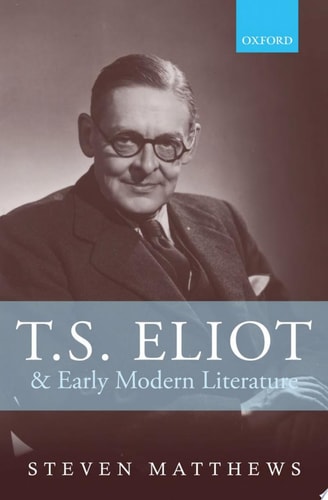
T.S. Eliot and Early Modern Literature
0
0
As an Amazon Associate and affiliate partner, Menrva Books earns from qualifying purchases. Learn more
Author Description
T.S. Eliot and Early Modern Literature, for the first time, considers the full imaginative and moral engagement of one of the most influential poets of the twentieth century, T.S. Eliot, with the Early Modern period of literature in English (1580-1630). This engagement haunted Eliot's poetry and critical writing across his career, and would have a profound impact on subsequent poetry across the world, as well as upon academic literary criticism, and wider cultural perceptions. To this end, the book elucidates and contextualizes several facets of Eliot's thinking and its impact: through establishment of his original and eclectic understanding of the Early Modern period in relation to the literary and critical source materials available to him; through consideration of uncollected and archival materials, which suggest a need to reassess established readings of the poet's career; and through attention to Eliot's resonant formulations about the period in consequent literary, critical and artistic arenas. To the end of his life, Eliot had to fend off the presumption that he had, in some way, 'invented' the Early Modern period for the modern age. Yet the presumption holds some force - it is famously and influentially an implication running through Eliot's essays on that earlier period, and through his many references to its writings in his poetry, that the Early Modern period formed the most exact historical analogy for the apocalyptic events (and consequent social, cultural and literary turmoil) of the first half of the twentieth-century. T.S. Eliot and Early Modern Literature gives a comprehensive sense of the vital engagement of this self-consciously modern poet with the earlier period he always declared to be his favourite.
Menrva's Summary
THE THESIS
This book investigates the profound and enduring intellectual engagement between T.S. Eliot and the literature of the Early Modern period (1580-1630). Steven Matthews, a scholar of modern literature, utilizes a combination of published essays, uncollected writings, and archival materials to argue that Eliot's interpretation of the Early Modern era was not merely academic, but a foundational framework for his own poetic output and his perception of twentieth-century cultural turmoil. By examining how Eliot positioned the Early Modern period as a historical mirror to his own time, Matthews provides a reassessment of the poet's critical legacy and his influence on subsequent literary studies.
THE SCOPE MAP
What You Will Find
- An analysis of Eliot's specific literary and critical source materials from the 1580-1630 period.
- Examination of previously uncollected and archival documents to challenge existing interpretations of Eliot's career.
- A study of the historical analogy between Early Modern social upheaval and the apocalyptic events of the early twentieth century.
- An exploration of how Eliot's critical formulations shaped modern academic perceptions of the Elizabethan and Jacobean eras.
THE AUTHORITY PERSPECTIVE
Scholars and critics recognize this work as a significant contribution to the study of Eliot's critical methodology and his relationship with the literary canon. Readers frequently note the academic density of the prose, which is intended for those with a specialized interest in modernist studies and literary history.
Page Count:
235
Publication Date:
2013-04-22
Publisher:
Oxford University Press
ISBN-10:
0199574774
ISBN-13:
9780199574773
Poetry
Biography
Academic
Modernism
Early Modern
Literary Criticism
Community Tags
Similar Books