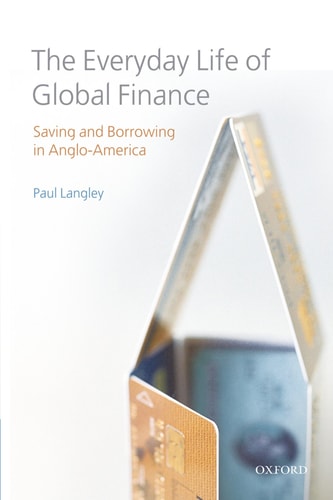
The Everyday Life of Global Finance: Saving and Borrowing in Anglo-America
0
0
As an Amazon Associate and affiliate partner, Menrva Books earns from qualifying purchases. Learn more
Author Description
In the US and UK, saving and borrowing routines have changed radically and become closely bound-up with the capital markets of global finance. As mutual funds have increased in popularity and pension provision has been transformed, many more individuals and households have come to invest in stocks and shares. As consumer borrowing has risen dramatically and mortgage finance has been extended to those deemed sub-prime, so the repayments of credit card holders and mortgagors have provided the basis for the issue and trading of bonds and other market instruments.The Everyday Life of Global Finance explores the unprecedented relationships that now bind society and the markets, challenging the dominant tendency to simply position recent developments in Wall Street and the City of London at the centre of contemporary finance. Grounded in literature from the sociology of finance and international political economy, drawing on the social theory of Callon, Foucault, and Latour, and informed by extensive empirical research, the book shows how global finance has become mundane and ordinary in Anglo-America. Finance is not 'out there somewhere', but is embedded in the calculative technologies and performances of reconfigured saving and borrowing networks, and is embodied through the assembly of everyday financial identities and self-disciplines. Society's new-found relationships with the financial markets are also shown, however, to be marked by stark inequalities, manifest contradictions, and political dissent.The Everyday Life of Global Finance is thus an ambitious and innovative contribution to our understanding of the contemporary financial world.
Menrva's Summary
THE THESIS
This book investigates how global financial markets have become deeply embedded in the mundane, everyday routines of saving and borrowing within Anglo-American societies. Paul Langley, an expert in international political economy, utilizes a framework rooted in the sociology of finance and social theory to challenge the perception that finance exists solely within elite institutions like Wall Street or the City of London. By analyzing the shift toward individual investment and consumer credit, the author argues that global finance is performed through the daily calculative technologies and self-disciplines of ordinary households.
THE SCOPE MAP
What You Will Find
- Analysis of the transformation of pension systems and the rise of mutual fund participation among individuals.
- Examination of the relationship between consumer credit, mortgage debt, and the issuance of market-traded financial instruments.
- Application of social theories from Callon, Foucault, and Latour to explain financial behavior.
- Empirical research detailing the inequalities, contradictions, and political dissent inherent in modern financialized life.
THE AUTHORITY PERSPECTIVE
Scholars in the field of political economy frequently cite this work for its innovative approach to bridging the gap between macro-level financial markets and micro-level household behavior. Readers often note the academic density of the prose, which requires a foundational understanding of social theory to fully grasp the author's arguments.
Page Count:
320
Publication Date:
2010-01-18
Publisher:
Oxford University Press
ISBN-10:
0199573964
ISBN-13:
9780199573967
Economics
Globalization
Finance
United States
Sociology
Great Britain
Credit
Community Tags
Similar Books