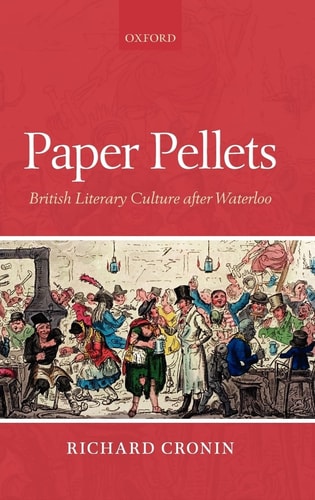
Paper Pellets: British Literary Culture after Waterloo
0
0
As an Amazon Associate and affiliate partner, Menrva Books earns from qualifying purchases. Learn more
Author Description
This study of the literary culture in Britain in the years after Waterloo begins with an account of two fatal duels, the famous duel of 16 February 1821, in which John Scott, editor of the London Magazine, fell, and the less well known duel of 26 March 1822, in which Alexander Boswell, son of Johnson's biographer, was killed. These duels, Richard Cronin suggests, bring into sharp focus the distinctive features of literary culture in the years after Waterloo. The book ranges widely but at its centre are the three literary phenomena that best define the period: Walter Scott's novels, Byron's Don Juan, and the new literary magazines. It was a culture constituted not by the doctrine of sympathy that its leading writers held in common but by the antagonisms that divided them, a culture in which England vied with Scotland, literary and political principles converged, and there was a volatile relationship between the public and the private. These were the years in which publishing became an industry serving a mass readership, and literature came to be decisively identified with print rather than with manuscript. Its most prized cultural products were miscellaneous. Superficial, even heartless, responses to the world were valued. Male writers responded aggressively to the threat that literature might be a kind of writing largely consumed by women and increasingly produced by them. This was the culture that writers such as Wordsworth repudiated, but the relationship between the culture that Wordsworth represented and the culture that he opposed, like the relationship between duellists, was at once violently aggressive and mutually supportive: each, as many writers of the period recognized, was dependent on the other.
Menrva's Summary
THE THESIS
This study investigates how the volatile literary culture of post-Waterloo Britain was defined by intense professional antagonisms rather than shared aesthetic values. Richard Cronin, an expert in Romantic-era literature, utilizes the historical context of fatal duels between prominent editors and writers to frame the period's aggressive competitive environment. He argues that the rise of mass-market publishing and the emergence of literary magazines created a landscape where political and personal conflicts were inseparable from literary production.
THE SCOPE MAP
What You Will Find
- Analysis of the transition from manuscript-based culture to industrial-scale print media.
- Examination of the rivalry between major figures such as Walter Scott and Lord Byron.
- Investigation into the gendered dynamics of authorship and readership in the early 19th century.
- Case studies of high-profile duels as indicators of broader social and literary tensions.
THE AUTHORITY PERSPECTIVE
Scholars recognize this work as a significant contribution to the understanding of Romantic-era publishing dynamics and the professionalization of the literary field. Readers frequently note the dense, analytical prose that effectively connects historical events to broader cultural shifts in British society.
Page Count:
300
Publication Date:
2010-07-29
Publisher:
Oxford University Press
ISBN-10:
019958253X
ISBN-13:
9780199582532
History
Great Britain
19th Century
British History
Literary Criticism
Community Tags
Similar Books