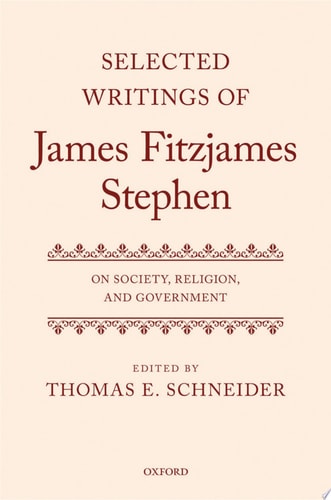
Selected Writings of James Fitzjames Stephen: On Society, Religion, and Government
0
0
As an Amazon Associate and affiliate partner, Menrva Books earns from qualifying purchases. Learn more
Author Description
James Fitzjames Stephen (1829-1894) is remembered as a judge, legal historian, and the author of Liberty, Equality, Fraternity, a reply to J. S. Mill's late works. He is less well remembered for his journalism, though it earned him a reputation among his contemporaries as one of the most trenchant writers on topics ranging across the social, religious, political, moral, and philosophical questions debated in his time. It was largely in his journalistic writing that Stephen set forth his views on these questions. Despite such a reputation, however, only a small proportion of this writing was collected during his lifetime, and very little has been republished since his death.Selected Writings of James Fitzjames Stephen: On Society, Religion, and Government includes thirty-five essays expressing Stephen's views on the questions of his day, which have not lost their interest in ours. He wrote at a time when much of the finest writing in English was published in periodicals, often anonymously. The essays in this volume are drawn mostly from Stephen's unsigned contributions to the Saturday Review, with additions, both signed and unsigned, from other periodicals, extending from the 1850s to the 1880s.
Menrva's Summary
THE THESIS
This volume investigates the intellectual contributions of James Fitzjames Stephen to 19th-century British discourse by curating his previously neglected journalistic essays on social, religious, and political governance. Editor Thomas E. Schneider compiles thirty-five essays to demonstrate how Stephen’s rigorous, often contrarian, perspective served as a critical counterpoint to the prevailing liberal philosophies of his era. By drawing from anonymous contributions to periodicals like the Saturday Review, the collection provides a comprehensive look at the development of Stephen’s thought from the 1850s through the 1880s.
THE SCOPE MAP
What You Will Find
- A curated selection of thirty-five essays covering social, religious, and political themes.
- Primary source material originally published anonymously in 19th-century British periodicals.
- An examination of Stephen’s intellectual evolution during the Victorian era.
- Contextual analysis of the debates surrounding liberty, equality, and state authority.
THE AUTHORITY PERSPECTIVE
Scholars and historians identify this collection as a vital resource for understanding the intellectual climate of the Victorian period, particularly regarding the critique of J.S. Mill. Readers frequently note the academic density of the prose, which serves as a foundational text for those studying 19th-century political philosophy.
Page Count:
450
Publication Date:
2015-09-16
Publisher:
Oxford University Press
ISBN-10:
0199585717
ISBN-13:
9780199585717
History
Philosophy
Legal History
Essays
19th Century
Community Tags
Similar Books