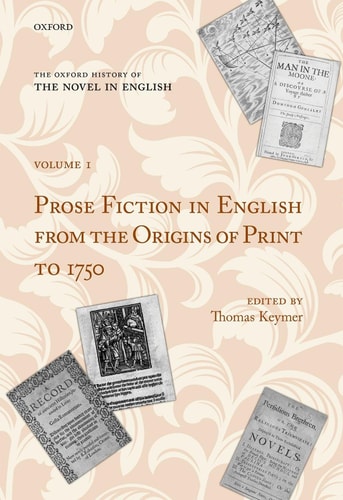
The Oxford History of the Novel in English: Volume 1: Prose Fiction in English from the Origins of Print to 1750
0
0
As an Amazon Associate and affiliate partner, Menrva Books earns from qualifying purchases. Learn more
Author Description
The Oxford History of the Novel in English is a 12-volume series presenting a comprehensive, global, and up-to-date history of English-language prose fiction and written by a large, international team of scholars. The series is concerned with novels as a whole, not just the 'literary' novel, and each volume includes chapters on the processes of production, distribution, and reception, and on popular fiction and the fictional sub-genres, as well as outlining the work of major novelists, movements, traditions, and tendencies.Volume 1 explores the long period between the origins of printing in late fifteenth-century England and the establishment of the novel as a recognized, reputable genre in the mid eighteenth century. Later chapters in the volume provide original, authoritative accounts of innovations by the major canonical authors, notably Defoe, Richardson, and Fielding, who have traditionally been seen as pioneering 'the rise of the novel', in Ian Watt's famous phrase. With its extended chronological and geographical range, however, the volume also contextualizes these eighteenth-century developments in revelatory new ways, to provide a fresh, bold, and comprehensive account of the richness and variety of fictional traditions as they developed over two and a half centuries.The volume thus establishes a newly comprehensive mapping of early fiction that rectifies the shortcomings and exclusions of established 'rise of the novel' scholarship. These include the relative neglect of the importance of women writers, following Behn's reinvention of romance in the 1680s, in shaping novelistic themes and techniques; a restrictive generic definition based on circumstantial and psychological realism to the exclusion of non-realist modes that flourished for centuries beforehand; a teleological bias that overlooks or downgrades phases and types of fiction production, such as the richly variegated category of Elizabethan fiction, that resist being assimilated into narratives of evolution or ascent; a reductive Anglocentrism that leaves out of account the translation, reception, and pervasive influence from the sixteenth century onwards of, among much else, the 'ancient novel' of Apuleius and Heliodorus; Byzantine, Arabian, and Eastern traditions; the Italian novella from Boccaccio to Bandello; Spanish picaresque and anti-romance; and a range of French narrative modes from Rabelais to Marivaux. Alongside these key contexts, the volume treats the emergent novel as, above all, a phenomenon of print culture, with close attention to conditions of authorship, publishing, and reading across the extended period.
Menrva's Summary
THE THESIS
This volume investigates the evolution of English prose fiction from the inception of the printing press in the late fifteenth century through the mid-eighteenth century. Edited by Thomas Keymer, this work assembles an international team of scholars to challenge traditional, narrow narratives regarding the 'rise of the novel.' By examining production, distribution, and reception alongside canonical texts, the authors provide a comprehensive framework that reevaluates the development of fictional traditions beyond the standard focus on eighteenth-century realism.
THE SCOPE MAP
What You Will Find
- Analysis of the transition from early print culture to the establishment of the novel as a recognized genre.
- Examination of the role of women writers, including Aphra Behn, in shaping early novelistic techniques.
- Critical reassessment of non-realist modes of fiction that preceded the eighteenth-century focus on psychological realism.
- Detailed accounts of major authors such as Defoe, Richardson, and Fielding within their broader historical and cultural contexts.
THE AUTHORITY PERSPECTIVE
Scholars and students of literary history frequently cite this volume as a foundational reference for understanding the pre-modern roots of the English novel. Experts highlight the text for its academic rigor and its success in broadening the scope of traditional literary scholarship to include previously marginalized genres and authors.
Page Count:
744
Publication Date:
2018-01-13
Publisher:
Oxford University Press
ISBN-10:
0199580030
ISBN-13:
9780199580033
History
Non-Fiction
Literary Criticism
Academic
Reference
Community Tags
Similar Books




Reader Comments
Share Your Thoughts
No comments yet. Be the first to share your thoughts!