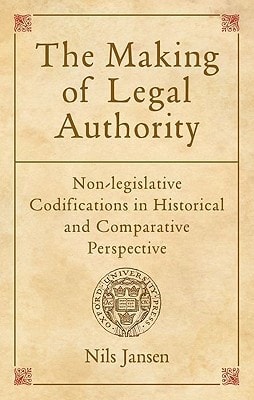
The Making of Legal Authority: Non-legislative Codifications in Historical and Comparative Perspective
0
0
As an Amazon Associate and affiliate partner, Menrva Books earns from qualifying purchases. Learn more
Author Description
Accounts of the nature of legal authority typically focus on the authority of officially sanctioned rules issued by legally recognised bodies - legislatures, courts and regulators - that fit comfortably within traditional state-centred concepts of law. Such accounts neglect the more complex processes involved in acquiring legal authority.Throughout the history of modern legal systems texts have come to acquire authority for legal officials without being issued by a legislature or a court. From Justinian's Institutes and Blackstone's Commentaries to modern examples such as the American Law Institute's Restatements and the UNIDROIT Principles of International Commercial Contracts academic codifications have come to be seen as legally authoritative, and their norms applied as such in courts and other contexts.How have such texts acquired legal authority? Does their authority undermine the orthodox accounts of the nature of legal systems? Drawing on examples from Roman law to the present day, this book offers the first comparative analysis of non-legislative codifications. It offers a provocative contribution to the debates surrounding the harmonisation of European private law, and the growth of international law.
Menrva's Summary
THE THESIS
This book investigates how non-legislative texts acquire legal authority and whether their influence challenges traditional state-centered models of law. Nils Jansen, a scholar of legal history and comparative law, examines the historical and contemporary mechanisms by which academic codifications—such as the Restatements of the Law or the UNIDROIT Principles—gain binding status in legal practice. By analyzing the evolution of legal systems from Roman law to modern international frameworks, the author argues that legal authority is a more complex, decentralized process than orthodox theories suggest.
THE SCOPE MAP
What You Will Find
- Historical analysis of non-legislative codifications ranging from Justinian's Institutes to Blackstone's Commentaries.
- Comparative study of modern instruments like the American Law Institute's Restatements and UNIDROIT Principles.
- Theoretical framework addressing the intersection of academic authority and judicial application.
- Discussion on the implications for the harmonization of European private law and the expansion of international legal norms.
THE AUTHORITY PERSPECTIVE
Legal scholars and historians recognize this work as a significant contribution to the study of legal pluralism and the nature of authority. Experts frequently highlight the text for its rigorous comparative methodology and its ability to bridge historical legal developments with contemporary debates in international law.
Page Count:
192
Publication Date:
2010-05-26
Publisher:
Oxford University Press
ISBN-10:
0199588767
ISBN-13:
9780199588763
Legal History
Law
Jurisprudence
Comparative Law
Private Law
Community Tags
Similar Books