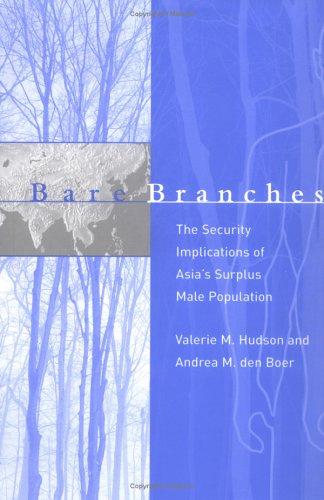
Bare Branches: Security Implications of Asia's Surplus Male Population
0
0
As an Amazon Associate and affiliate partner, Menrva Books earns from qualifying purchases. Learn more
Author Description
What happens to a society that has too many men? In this book, Valerie Hudson and Andrea den Boer argue that, historically, high male-to-female ratios often trigger domestic and international violence. Most violent crime is committed by young unmarried males who lack stable social bonds. Although there is not always a direct cause-and-effect relationship, these surplus men often play a crucial role in making violence prevalent within society. Governments sometimes respond to this problem by enlisting young surplus males in military campaigns and high-risk public works projects. Countries with high male-to-female ratios also tend to develop authoritarian political systems.--BOOK JACKET.
Menrva's Summary
THE THESIS
The imbalance of male and female populations in Asia creates significant security risks, both domestically and internationally. Valerie Hudson and Andrea den Boer posit that societies with a surplus of men, particularly young, unmarried males lacking social bonds, are historically predisposed to increased violence. This demographic phenomenon can lead to higher rates of crime and can influence governmental decisions, such as engaging surplus males in military conflicts or risky public works. Furthermore, the authors suggest a correlation between high male-to-female ratios and the development of authoritarian political systems.
THE SCOPE MAP
- Analysis of demographic data on male-to-female ratios in Asian countries.
- Exploration of the historical link between surplus males and societal violence.
- Examination of government responses to demographic imbalances, including military conscription and public works.
- Discussion of the relationship between demographic sex ratios and political systems, particularly authoritarianism.
- Case studies illustrating the security implications of surplus male populations.
- Theoretical framework connecting demographic trends to international security concerns.
THE AUTHORITY PERSPECTIVE
This book presents a compelling, albeit controversial, thesis linking demographic sex ratios to societal violence and political instability. The authors' rigorous analysis of historical data and contemporary trends has sparked considerable academic discussion regarding the complex interplay between population dynamics and international security. The work is recognized for its bold arguments and its contribution to understanding the root causes of conflict in regions with skewed sex ratios. It is considered a significant, if debated, contribution to the fields of demography, political science, and international relations.
Page Count:
339
Publication Date:
2005-01-01
ISBN-10:
0262582643
ISBN-13:
9780262582643
Non-Fiction
History
Politics
Sociology
International relations
Demographics
Social Science
Community Tags
Similar Books