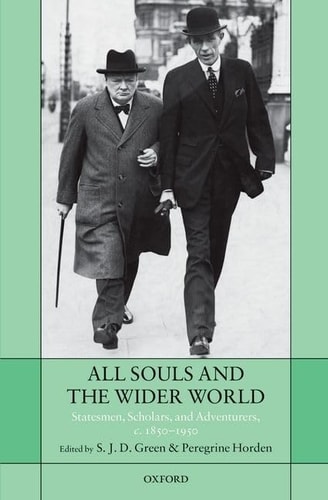
All Souls and the Wider World: Statesmen, Scholars, and Adventurers, c. 1850-1950
0
0
As an Amazon Associate and affiliate partner, Menrva Books earns from qualifying purchases. Learn more
Author Description
All Souls College, Oxford, has been both widely praised and roundly abused for its fellows' non-academic pursuits. How was it that members of the college so often held dual citizenship in the worlds of learning and public affairs? Why, instead of becoming teaching 'dons', could they be found in government and politics, in law, diplomacy, and running the empire, in formulating foreign policy (including, supposedly, 'appeasement' of Hitler), in banking, journalism, and the 'republic of letters'? Part of the answer lies in the nature of the foundation. Chichele's medieval college was always meant to be a training ground for careers in Church and government. But the origins of the modern phenomenon of 'prize fellows' active in a wider world beyond Oxford lies in the history of the College during the decades around 1900, and in its 'second foundation' by the Warden, Sir William Anson. The studies collected in this volume explore the context, significance, and legacy of Anson's wardenship. They trace the activities of 'prize' and other fellows, both individually and in groups, in settings that range geographically from London to the capitals of empire and commonwealth in Africa, India, and Australia, and chronologically from the years preceding the First World War to the Suez crisis.
Menrva's Summary
THE THESIS
This volume investigates the historical mechanisms that allowed fellows of All Souls College, Oxford, to maintain dual roles as both academic scholars and influential figures in public affairs, government, and the British Empire between 1850 and 1950. Editors Peregrine Horden and S. J. D. Green examine the evolution of the 'prize fellow' model, arguing that the college's unique institutional structure, particularly under the wardenship of Sir William Anson, facilitated a culture where intellectual life and statecraft were deeply intertwined. By analyzing the careers of various fellows, the contributors demonstrate how the college functioned as a nexus for the British political and administrative elite during a century of significant global transition.
THE SCOPE MAP
What You Will Find
- Historical analysis of the 'second foundation' of All Souls College under Warden Sir William Anson.
- Examination of the professional trajectories of fellows in law, diplomacy, banking, journalism, and colonial administration.
- Geographical coverage spanning London, Africa, India, and Australia.
- Chronological focus on the period from the late Victorian era through the Suez crisis.
THE AUTHORITY PERSPECTIVE
Experts identify this collection as a significant contribution to the institutional history of Oxford and the study of the British intellectual elite. Readers frequently note the academic density of the prose, which provides a rigorous examination of the intersection between scholarly life and imperial governance.
Page Count:
352
Publication Date:
2012-09-08
Publisher:
Oxford University Press
ISBN-10:
0199593701
ISBN-13:
9780199593705
History
Biography
Education
British History
Academic
Community Tags
Similar Books