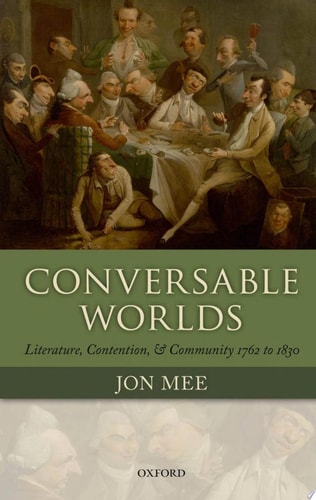
Conversable Worlds: Literature, Contention, and Community 1762 to 1830
0
0
As an Amazon Associate and affiliate partner, Menrva Books earns from qualifying purchases. Learn more
Author Description
Conversable Worlds addresses the emergence of the idea of 'the conversation of culture'. Around the year 1700 a new commercial society was emerging that thought of its values as the product of exchanges between citizens. Conversation became increasingly important as a model and as a practice for how community could be created. A welter of publications, in periodical essays, in novels, and in poetry, enjoined the virtues of conversation. These publications were enthusiastically read and discussed in book clubs and literary societies that created their own conversable worlds. From some perspectives, the freedom of a distinctively English conversation allowed for the 'collision' of ideas and sentiments. For others, like Joseph Addison and David Hume, ease of 'flow' was the key issue, and politeness the means of establishing a via media. For Addison and Hume, the feminization of culture promised to make women the sovereigns of what Hume called 'the conversable world'. As the culture seemed to open up to a multitude of voices, anxieties appeared as to how far things should be allowed to go. The unruliness of the crowd threatened to disrupt the channels of communication. There was a parallel fear that mere feminized chatter might replace learning. This book examines the influence of these developments on the idea of literature from 1762 through to 1830. Part I examines the conversational paradigm established by figures like Addison and Hume, and the proliferation of conversable worlds into gatherings like Johnson's Club and Montagu's Bluestocking assemblies. Part II looks at the transition from the eighteenth century to 'Romantic' ideas of literary culture, the question of the withdrawal from mixed social space, the drive to sublimate verbal exchange into forms that retained dialogue without contention in places like Coleridge's 'conversation poems,' and the continuing tensions between ideas of the republic of letters as a space of vigorous exchange as opposed to the organic unfolding of consciousness.
Menrva's Summary
THE THESIS
This book investigates how the concept of 'conversable worlds' shaped the development of literary culture and social exchange in Britain between 1762 and 1830. Jon J. Mee, a scholar of Romantic-era literature and culture, utilizes a wide array of historical texts—including periodicals, novels, and poetry—to argue that conversation served as both a model for community building and a site of intense cultural anxiety. He examines how the tension between polite, feminized discourse and the fear of unruly, public debate influenced the evolution of literary forms during this transformative period.
THE SCOPE MAP
What You Will Find
- Analysis of the conversational paradigm established by figures such as Joseph Addison and David Hume.
- Examination of social institutions including book clubs, literary societies, and the Bluestocking assemblies.
- Investigation into the transition from Enlightenment ideals of social exchange to Romantic-era literary practices.
- Discussion of the influence of gender dynamics and class anxieties on the perceived legitimacy of public discourse.
THE AUTHORITY PERSPECTIVE
Scholars recognize this work as a significant contribution to the study of eighteenth-century sociability and the history of the public sphere. Readers frequently note the academic density of the prose and the author's meticulous engagement with primary source materials from the period.
Page Count:
336
Publication Date:
2011-11-10
Publisher:
Oxford University Press
ISBN-10:
0199591741
ISBN-13:
9780199591749
History
Romanticism
Literary Criticism
Literature
18th century
Community Tags
Similar Books