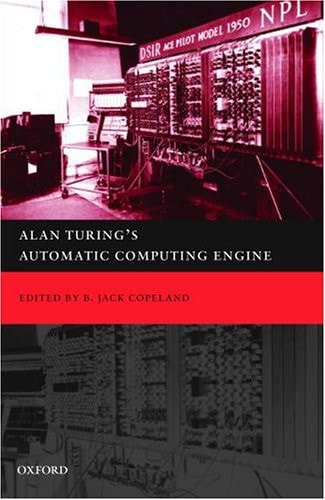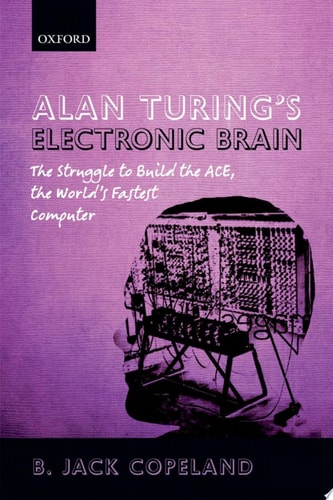
Alan Turing's Electronic Brain: The Struggle to Build the ACE, the World's Fastest Computer
0
0
As an Amazon Associate and affiliate partner, Menrva Books earns from qualifying purchases. Learn more
Author Description
The mathematical genius Alan Turing, now well known for his crucial wartime role in breaking the ENIGMA code, was the first to conceive of the fundamental principle of the modern computer-the idea of controlling a computing machine's operations by means of a program of coded instructions, stored in the machine's 'memory'. In 1945 Turing drew up his revolutionary design for an electronic computing machine-his Automatic Computing Engine ('ACE'). A pilot model of the ACE ran its first program in 1950 and the production version, the 'DEUCE', went on to become a cornerstone of the fledgling British computer industry. The first 'personal' computer was based on Turing's ACE.Alan Turing's Automatic Computing Engine describes Turing's struggle to build the modern computer. The first detailed history of Turing's contributions to computer science, this text is essential reading for anyone interested in the history of the computer and the history of mathematics. It contains first hand accounts by Turing and by the pioneers of computing who worked with him. As well as relating the story of the invention of the computer, the book clearly describes the hardware and software of the ACE-including the very first computer programs. The book is intended to be accessible to everyone with an interest in computing, and contains numerous diagrams and illustrations as well as original photographs.The book contains chapters describing Turing's path-breaking research in the fields of Artificial Intelligence (AI) and Artificial Life (A-Life). The book has an extensive system of hyperlinks to The Turing Archive for the History of Computing, an on-line library of digital facsimiles of typewritten documents by Turing and the other scientists who pioneered the electronic computer.
Menrva's Summary
THE THESIS
This book investigates the technical and personal challenges Alan Turing faced while designing the Automatic Computing Engine (ACE) and his broader influence on the development of modern computing. B. Jack Copeland, a leading expert on Turing's work, utilizes primary source documents and historical records to reconstruct the timeline of the ACE project. The text argues that Turing's vision for stored-program computing was the foundational architecture for the modern digital age. By examining both the hardware specifications and the intellectual climate of post-war Britain, the author situates Turing's contributions within the wider evolution of computer science.
THE SCOPE MAP
What You Will Find
- Detailed technical analysis of the ACE hardware and software architecture.
- Historical accounts of the transition from the ACE pilot model to the commercial DEUCE computer.
- Primary source documentation including original programs and typewritten notes from Turing and his colleagues.
- Explorations of Turing's early research into Artificial Intelligence and Artificial Life.
THE AUTHORITY PERSPECTIVE
Experts recognize this work as a definitive historical account of Turing's engineering contributions, praised for its inclusion of rare archival materials. Readers frequently note the balance between technical detail and accessible narrative, making it a valuable resource for both historians and computer science professionals.
Page Count:
592
Publication Date:
2012-07-05
Publisher:
Oxford University Press
ISBN-10:
0199609152
ISBN-13:
9780199609154
Science
History
Biography
Computer Engineering
Computers
Mathematics
Technology
Computer Science
Community Tags
Similar Books