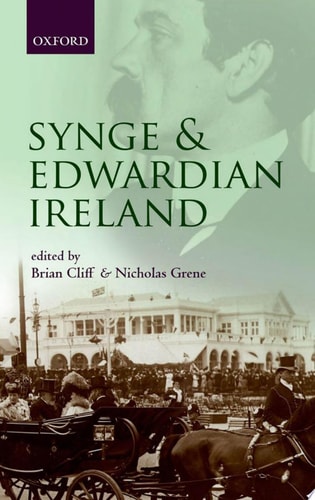
Synge and Edwardian Ireland
0
0
As an Amazon Associate and affiliate partner, Menrva Books earns from qualifying purchases. Learn more
Author Description
The dramatic career of the Irish playwright J.M. Synge, from his first plays in 1902 to his premature death in 1909, almost exactly coincided with the years of Edward VII's reign. Those years have long been studied in a British context, but Synge and Edwardian Ireland is the first book to explore the cultural life of Edwardian Ireland as a distinctive period. By emphasizing several less familiar Irish contexts for Synge's work - including a new sociological awareness, the rise of a local celebrity culture, an international theatre context, the arts and crafts movement, Irish classical music, and comedic writing by Somerville and Ross - this collection shows how the Revival's preoccupation with folk culture intersected with the new networks of mass communication in the late imperial world.Although Synge is best known as a dramatist, this book concentrates on his prose and the ethnography of his photographs, the work in which his engagement with Edwardian Ireland can be most significantly seen. Often misunderstood as apolitical, Synge's writings and photography display a romantic resistance to modernity alongside their more accurate observations of contemporary conditions. It is through this ambivalent modernity that his work continued to haunt not just advocates like W.B. Yeats but even Synge's critics, including Padraig Pearse and James Joyce, all of whom were forced to come to imaginative terms with Synge through their own work.This book aims to change readers' sense of Synge's significance, and by doing so to illuminate in a quite new way the era of Edwardian Ireland during this period of rapid modernization.
Menrva's Summary
THE THESIS
This book investigates the cultural life of Edwardian Ireland by situating the career of playwright J.M. Synge within the specific socio-political and artistic networks of the early twentieth century. Brian Cliff and Nicholas Grene utilize a multidisciplinary approach, drawing upon Synge's prose, ethnographic photography, and contemporary Irish contexts to challenge the perception of the author as an apolitical figure. By examining the intersection of the Irish Literary Revival with mass communication and modernization, the authors argue that Synge’s work reflects a complex, ambivalent engagement with his era that influenced his contemporaries and critics alike.
THE SCOPE MAP
What You Will Find
- A detailed analysis of the Irish Edwardian period as a distinct cultural and sociological era.
- Exploration of Synge's prose and ethnographic photography as primary evidence of his engagement with modernity.
- Contextual studies of the arts and crafts movement, local celebrity culture, and Irish classical music.
- Comparative assessments of Synge's influence on figures such as W.B. Yeats, Padraig Pearse, and James Joyce.
THE AUTHORITY PERSPECTIVE
Scholars and critics recognize this collection as a significant contribution to Irish studies that successfully recontextualizes Synge beyond his traditional reputation as a dramatist. The text is noted for its academic rigor and its ability to bridge the gap between literary analysis and historical sociology.
Page Count:
296
Publication Date:
2012-01-13
Publisher:
Oxford University Press
ISBN-10:
0199609888
ISBN-13:
9780199609888
Photography
Drama
History
Biography
Criticism history
Ireland
Irish History
Literary Criticism
Community Tags
Similar Books