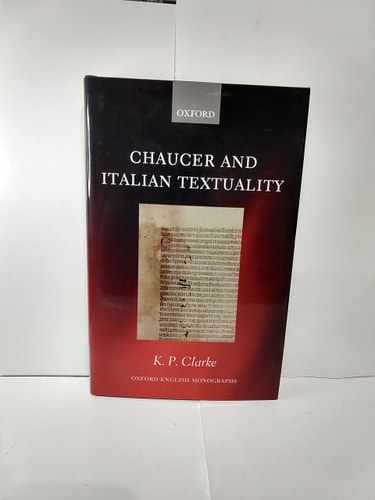
Chaucer and Italian Textuality
0
0
As an Amazon Associate and affiliate partner, Menrva Books earns from qualifying purchases. Learn more
Author Description
When Chaucer came into contact with Italian literary culture in the second half of the fourteenth century he was engaging with a productive, lively and highly varied tradition. Chaucer and Italian Textuality provides a new perspective on Chaucer and Italy by highlighting the materiality of his sources, reconstructing his textual, codicological horizon of expectation. It provides new ways of thinking about Chaucer's access to, and use of, these Italian sources, stimulating, in turn, new ways of reading his work. Manuscripts of the major works of Dante, Boccaccio, and Petrarch circulated in a variety of formats, and often the margins of their texts were loci for extensive commentary and glossing. These traditions of glossing and commentary represent one of the most striking features of fourteenth-century Italian literary culture. These authors were in turn deeply indebted to figures like Ovid and Statius, who were themselves heavily glossed and commented upon. The margins provided a space for a wide variety of responses to be inscribed on the page. This is eloquently demonstrated in the example of Francesco d'Amaretto Mannelli's glosses in Decameron, copied by him in 1384. This material dimension of Chaucer's sources has not received sufficient attention; this book aims to address just such a material textuality. This attention to the materiality of Chaucer's sources is further explored and developed by reading the Prologue to the Wife of Bath's Tale and the Clerk's Tale through their early fourteenth-century manuscripts, taking account not just of the text but also of the numerous marginal glosses. Within this context, then, the question of Chaucer's authorship of some of these glosses is considered.
Menrva's Summary
THE THESIS
This book investigates how the material culture of fourteenth-century Italian manuscripts, specifically the tradition of marginal glossing, influenced Geoffrey Chaucer’s literary production and his engagement with Italian sources. K. P. Clarke, a scholar of medieval literature, utilizes codicological analysis to argue that Chaucer’s interaction with the works of Dante, Boccaccio, and Petrarch was mediated by the physical layout of the manuscripts he encountered. By examining the margins as spaces for commentary and intellectual response, the author provides a framework for understanding how these textual layers shaped Chaucer’s own creative process and authorship. The study challenges traditional readings by shifting focus from the text alone to the material reality of the codex.
THE SCOPE MAP
What You Will Find
- Analysis of fourteenth-century Italian manuscript culture and codicological practices.
- Examination of marginal glossing traditions in the works of Dante, Boccaccio, and Petrarch.
- Case studies focusing on the Prologue to the Wife of Bath's Tale and the Clerk's Tale.
- Investigation into the potential authorship of specific marginal glosses found in Chaucerian manuscripts.
THE AUTHORITY PERSPECTIVE
Scholars in the field of medieval studies recognize this work as a significant contribution to the study of Chaucer’s source material and manuscript history. Readers frequently note the academic density of the prose and the specialized focus on codicology as essential for advanced students of late medieval literature.
Page Count:
256
Publication Date:
2011-09-02
Publisher:
Oxford University Press
ISBN-10:
019960777X
ISBN-13:
9780199607778
History
Criticism history
Literary Criticism
English literature
Academic
Community Tags
Similar Books