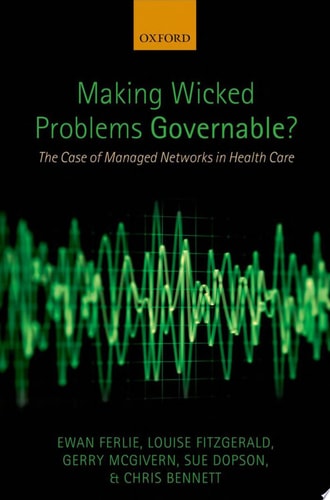
Making Wicked Problems Governable?: The Case of Managed Networks in Health Care
0
0
As an Amazon Associate and affiliate partner, Menrva Books earns from qualifying purchases. Learn more
Author Description
Over the last thirty years, scholars of health care organizations have been searching for concepts and images to illuminate their underlying, and shifting, modes of organizing. Nowhere has this controversy been more intense than in the United Kingdom, given the long succession of top down reorganizations within the National Health Service (NHS) over the last thirty years. This book characterises the nature of key reforms - namely managed networks - introduced in the UK National Health Service during the New Labour period (1997-2010), combining rich empirical case material of such managed networks drawn from different health policy arenas (clinical genetics, cancer networks, sexual health networks, and long term care) with a theoretically informed analysis.The book makes three key contributions. Firstly, it argues that New Labour's reforms included an important network element consistent with underlying network governance ideas, specifying conditions of 'success' for these managed networks and exploring how much progress was empirically evident. Secondly, in order to conceptualise many of the complex health policy arenas studied, the book uses the concept of 'wicked problems': problematic situations with no obvious solutions, whose scope goes beyond any one agency, often with conflicting stakeholder interests, where there are major social and behavioural dimensions to be considered alongside clinical considerations. Thirdly, it makes a contribution to the expanding Foucauldian and governmentality-based literature on health care organizations, by retheorising organizational processes and policy developments which do not fit either professional dominance or NPM models from a governmentality perspective.From the empirical evidence gathered, the book argues that managed networks (as opposed to alternative governance modes of hierarchy or markets) may well be the most suitable governance mode in those many and expanding policy arenas characterised by 'wicked problems', and should be given more time to develop and reach their potential.
Menrva's Summary
THE THESIS
This book investigates whether managed networks serve as an effective governance mechanism for addressing complex, multi-faceted health care challenges known as 'wicked problems'. The authors, a team of scholars specializing in health care organization and policy, utilize empirical data from the UK National Health Service during the New Labour era to evaluate the efficacy of network-based reforms. By applying a governmentality framework, the text challenges traditional models of professional dominance and New Public Management to propose that network governance offers a superior approach to policy arenas where stakeholder interests and social dimensions are deeply intertwined.
THE SCOPE MAP
What You Will Find
- Empirical case studies of clinical genetics, cancer, sexual health, and long-term care networks.
- An application of 'wicked problems' theory to health policy and organizational behavior.
- A theoretical analysis grounded in Foucauldian governmentality and organizational sociology.
- Comparative evaluation of managed networks against hierarchical and market-based governance modes.
THE AUTHORITY PERSPECTIVE
Experts recognize this work as a significant contribution to the study of public sector reform and organizational theory within the NHS. Readers frequently note the academic density of the prose, which serves as a rigorous resource for researchers and policy analysts interested in the intersection of governance and health care delivery.
Page Count:
304
Publication Date:
2013-05-19
Publisher:
Oxford University Press
ISBN-10:
0199603014
ISBN-13:
9780199603015
Management
Health Care
Sociology
Medical policy
Health Services
Public Policy
Community Tags
Similar Books







Reader Comments
Share Your Thoughts
No comments yet. Be the first to share your thoughts!