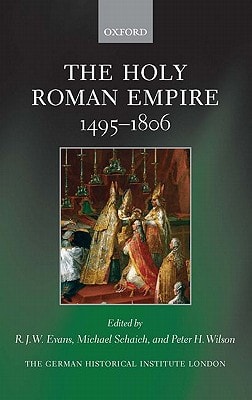
The Holy Roman Empire 1495-1806
0
0
As an Amazon Associate and affiliate partner, Menrva Books earns from qualifying purchases. Learn more
Author Description
Over the last forty years or so, research on the history of the Holy Roman Empire of the German Nation (1495-1806) has been transformed almost beyond recognition. Once derided as a political non-entity, a chaotic assemblage of countless principalities and statelets that lacked coercive power and was stifled by encrusted structures and procedures, the Reich has been fully rehabilitated by more recent historiography. It is now being hailed by some as a model of peaceful conflict resolution in the centre of Europe which, in the long run, was able to defuse the religious tensions created by the confessional divide of the sixteenth century and to protect its smaller members against the voracious appetite of more powerful neighbours. Some historians even draw lessons from the history of the Holy Roman Empire for our present. The multi-layered, federal structure of the old Empire and its system of collective decision-making have been held up as a model for a peace-loving, multi-ethnic Europe, a European Union avant la lettre. Other historians have described the Reich as the first German nation-state, a political configuration based not on power and expansion, but on rights and liberties, the rule of law and a structural lack of capacity for aggression.This volume takes stock of this research, particularly in the critical areas of the Empire's constitutional, religious and social history. A notable feature is the presentation of several decades of research in concise, accessible essays by continental scholars, much of it appearing in English for the first time.
Menrva's Summary
THE THESIS
This volume investigates the historical transformation of the Holy Roman Empire from a perceived political failure into a sophisticated model of federalism and conflict resolution. The editors, including Peter H. Wilson and R. J. W. Evans, compile research from the German Historical Institute to challenge outdated narratives that dismissed the Reich as a chaotic, powerless entity. By examining the Empire's constitutional, religious, and social frameworks, the contributors argue that the Reich functioned as a durable system of rights and collective decision-making that protected smaller states and mitigated confessional tensions.
THE SCOPE MAP
What You Will Find
- Analysis of the Holy Roman Empire's constitutional and legal structures between 1495 and 1806.
- Examination of the Empire's role in managing religious conflict following the sixteenth-century confessional divide.
- Synthesis of decades of continental historiography presented in English for the first time.
- Comparative perspectives on the Empire as a precursor to modern federalist systems and the European Union.
THE AUTHORITY PERSPECTIVE
Scholars and students of early modern European history frequently cite this collection as a vital resource for understanding the revisionist shift in Reich historiography. The text is noted for its academic rigor and its success in making complex German-language scholarship accessible to an English-speaking audience.
Page Count:
384
Publication Date:
2011-05-19
Publisher:
OUP/German Historical Institute London
ISBN-10:
0199602972
ISBN-13:
9780199602971
History
Political History
European History
Constitutional History
German history
Academic
Community Tags
Similar Books