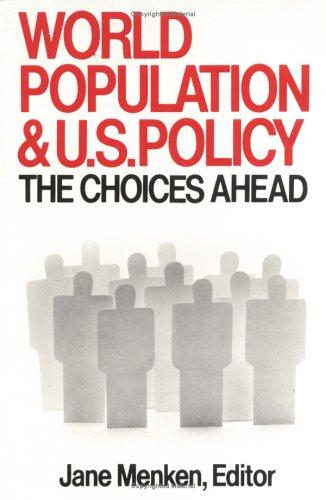
World Population and U.S. Policy
0
0
As an Amazon Associate and affiliate partner, Menrva Books earns from qualifying purchases. Learn more
Author Description
In 1963, the 23rd American Assembly issued a report calling attention to the rapid population growth in the underdeveloped world and concluded that such growth would asversely affect efforts to improve economic and social conditions in developing countries. The report called for significant and systematic American support for family planning and other population control measures in the Third World. This book is a response to the 1984 UN Conference on Population, which changed US policy and stated that "population growth is, of itself, a neutral phenomenon." The 1986 meeting of the 71st American Assembly brought together distinguished Americans from various sectors of our society to determine where the facts lead in the dispute about the relationship of population growth to economic development. Chapter titles include: 1) The World Demographic Situation, 2) Are the Economic Consequences of Population Growth a Sound Basis for Population Policy?, 3) Population trends and Economic Development, 4) The transition in Reproductive Behavior in the Third World, 5) Intersections: Immigration and Demographic Change and Their Impact on the United States, 6) Family Planning Programs, and 7) Population Policy: Choices for the United States.
Menrva's Summary
THE THESIS
The United States' approach to global population growth and its impact on economic development has undergone significant shifts, prompting a re-evaluation of policy. This book addresses the divergence in perspectives, particularly in response to the 1984 UN Conference on Population, which declared population growth a neutral phenomenon, contrasting with earlier views that emphasized its adverse effects on development. It convenes experts to examine the factual basis for current population policies, considering demographic trends, reproductive behavior, immigration, and the role of family planning programs in shaping both global and U.S. policy.
THE SCOPE MAP
- An analysis of the global demographic situation and its historical context.
- An examination of the economic consequences of population growth as a basis for policy.
- Exploration of population trends and their relationship to economic development.
- Discussion of the transition in reproductive behavior within the Third World.
- An analysis of immigration, demographic change, and their impact on the United States.
- An overview of family planning programs and their effectiveness.
- An exploration of population policy choices for the United States.
THE AUTHORITY PERSPECTIVE
The book's structure, based on the 71st American Assembly meeting, suggests a comprehensive, multi-faceted examination of population policy. The chapter titles indicate a thorough exploration of demographic trends, economic impacts, reproductive behavior, immigration, and specific policy recommendations for the United States. The inclusion of distinguished Americans from various sectors implies a balanced and authoritative perspective on a complex and evolving issue.
Page Count:
255
Publication Date:
1986-01-01
ISBN-10:
0393024199
Politics
History
Non-Fiction
Demographics
World history
International relations
Public Policy
Community Tags
Similar Books