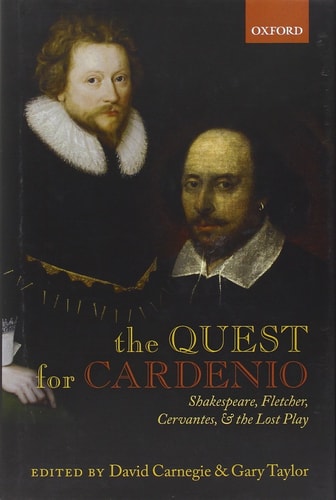
The Quest for Cardenio: Shakespeare, Fletcher, Cervantes, and the Lost Play
0
0
As an Amazon Associate and affiliate partner, Menrva Books earns from qualifying purchases. Learn more
Author Description
This book is about the search for a lost play. Celebrating the quatercentenary of publication of the first translation of Don Quixote, it is the first collection of essays entirely devoted to The History of Cardenio, a play based on Cervantes and probably written in that same year. It was said to be written by Shakespeare and the young man who was taking his place, John Fletcher, the most successful English playwright of the seventeenth century. The book brings together leading scholars, critics, and theatre practitioners to discuss the lost (or partially lost) play. It also re-examines Lewis Theobald's 1727 Double Falsehood, allegedly based on Cardenio. A range of approaches -new archival evidence, employment of advanced computer-aided stylometric tests for authorship attribution, early modern theatre history, literary and theatrical analysis, musicology, and recent theatrical productions and adaptations - produces new research findings about the play, Shakespeare, Fletcher, Cervantes, and the early modern relationship between Spanish and English culture. The book establishes the dates, venues, and audience for two performances of Cardenio by the King's Men in 1613, and identifies glimpses of the play in several seventeenth-century documents. It also provides much new evidence and analysis of Double Falsehood, which Theobald claimed was based on previously unknown manuscripts of a play by Shakespeare. His enemies, especially Pope, denied the Shakespeare attribution. Debate has continued ever since. While some contributors advocate sceptical caution, new research provides stronger evidence than ever before that a lost Fletcher/Shakespeare Cardenio can be discerned within Double Falsehood. Uniquely, this collection combines archival research and literary analysis with accounts of recent theatrical experiments, which explore the Cardenio problem by reviving or adapting Double Falsehood, and demonstrate that such practical theatrical work throws valuable light on some of the problems that have obstructed traditional scholarly approaches. It thus offers a new paradigm for the creative interaction of scholarship and performance.
Menrva's Summary
THE THESIS
*This collection investigates the historical existence and potential authorship of the lost play The History of Cardenio, attributed to William Shakespeare and John Fletcher. Editors David Carnegie and Gary Taylor assemble a multidisciplinary team of scholars, critics, and theatre practitioners to evaluate the connection between this lost work and Lewis Theobald’s 1727 play, Double Falsehood*. By synthesizing archival research, stylometric analysis, and theatrical performance history, the authors argue that evidence for a Shakespearean and Fletcherian origin of the source material is more robust than previously acknowledged.
THE SCOPE MAP
What You Will Find
- Stylometric and computer-aided authorship attribution tests applied to early modern texts.
- Historical analysis of the 1613 King's Men performances and seventeenth-century documentation.
- Comparative literary and theatrical examination of Double Falsehood against the Don Quixote narrative.
- Documentation of modern theatrical experiments and adaptations aimed at reconstructing the lost play.
THE AUTHORITY PERSPECTIVE
Experts recognize this volume as a significant contribution to the ongoing debate regarding the Shakespeare-Fletcher canon and the authenticity of Double Falsehood. Readers frequently note the academic density of the prose, which serves as a foundational resource for scholars interested in early modern theatre history and attribution methodology.
Page Count:
432
Publication Date:
2012-10-25
Publisher:
Oxford University Press
ISBN-10:
0199641811
ISBN-13:
9780199641819
Drama
History
Theatre History
Shakespeare
Academic
Literary Criticism
Community Tags
Similar Books



Reader Comments
Share Your Thoughts
No comments yet. Be the first to share your thoughts!