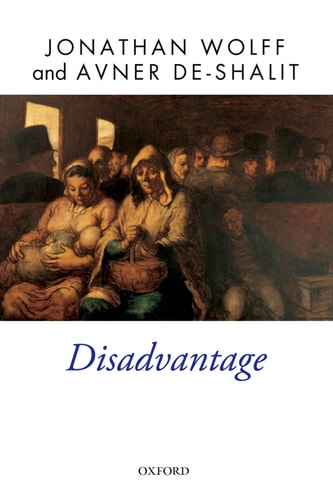
Disadvantage
0
0
As an Amazon Associate and affiliate partner, Menrva Books earns from qualifying purchases. Learn more
Author Description
What does it mean to be disadvantaged? Is it possible to compare different disadvantages? What should governments do to move their societies in the direction of equality, where equality is to be understood both in distributional and social terms? Linking rigorous analytical philosophical theory with broad empirical studies, including interviews conducted for the purpose of this book, Wolff and de-Shalit show how taking theory and practice together is essential if the theory is to be rich enough to be applied to the real world, and policy systematic enough to have purpose and justification.The book is in three parts. Part 1 presents a pluralist analysis of disadvantage, modifying the capability theory of Sen and Nussbaum to produce the 'genuine opportunity for secure functioning' view. This emphasises risk and insecurity as a central component of disadvantage. Part 2 shows how to identify the least advantaged in society even on a pluralist view. The authors suggest that disadvantage 'clusters' in the sense that some people are disadvantaged in several different respects. Thus identifying the least advantaged is not as problematic as it appears to be. Conversely, a society which has 'declustered disadvantaged' - in the sense that no group lacks secure functioning on a range of functionings - has made considerable progress in the direction of equality. Part 3 explores how to decluster disadvantage, by paying special attention to 'corrosive disadvantages' - those disadvantages which cause further disadvantages - and 'fertile functionings' - those which are likely to secure other functionings.In sum this book presents a refreshing new analysis of disadvantage, and puts forward proposals to help governments improve the lives of the least advantaged in their societies, thereby moving in the direction of equality.Oxford Political Theory presents the best new work in contemporary political theory. It is intended to be broad in scope, including original contributions to political philosophy, and also work in applied political theory. The series will contain works of outstanding quality with no restriction as to approach or subject matter. Series Editors: Will Kymlicka, David Miller, and Alan Ryan.
Menrva's Summary
THE THESIS
This book investigates the conceptual definition of disadvantage and proposes a framework for governments to effectively address social and distributional inequality. Authors Avner de-Shalit and Jonathan Wolff, both established scholars in political philosophy, bridge the gap between abstract theory and empirical reality. By synthesizing the capability approach of Sen and Nussbaum with original qualitative research, they argue that disadvantage is best understood through the lens of risk, insecurity, and the clustering of negative outcomes.
THE SCOPE MAP
What You Will Find
- A pluralist analysis of disadvantage utilizing the 'genuine opportunity for secure functioning' framework.
- Methodologies for identifying the least advantaged populations through the concept of disadvantage clustering.
- Empirical evidence derived from original interviews and social studies.
- Strategic policy recommendations focused on mitigating 'corrosive disadvantages' and promoting 'fertile functionings'.
THE AUTHORITY PERSPECTIVE
Experts recognize this work as a significant contribution to contemporary political theory, particularly for its practical application of philosophical concepts to public policy. Readers frequently note the clarity with which the authors navigate complex academic debates while maintaining a focus on real-world social improvement.
Page Count:
248
Publication Date:
2013-03-22
Publisher:
Oxford University Press
ISBN-10:
0199655588
ISBN-13:
9780199655588
Philosophy
Sociology
Equality
Social policy
Poor
Community Tags
Similar Books




Reader Comments
Share Your Thoughts
No comments yet. Be the first to share your thoughts!