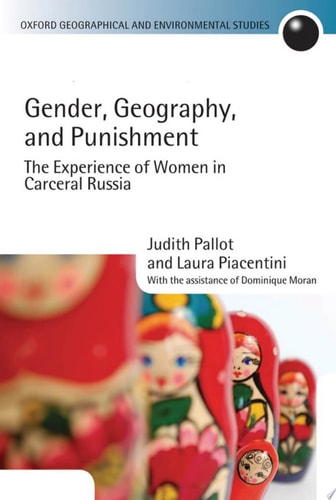
Gender, Geography, and Punishment: The Experience of Women in Carceral Russia
0
0
As an Amazon Associate and affiliate partner, Menrva Books earns from qualifying purchases. Learn more
Author Description
This book is the first of its kind that brings together human geography and the sociology of punishment to explore the relationship between distance and punishment in con-temporary Russia. Using established penological and geographical theories, the book presents in-depth empirical research to show how the experiences of women prisoners are shaped by the distances that the Russian penal service sends prisoners to serve their sentences. Its most eye-catching feature is its use of interviews conducted by the authors and their research team with adult and juvenile women prisoners, ex-prisoners and prison officers in penal facilities in different regions of the Russian Federation between 2006 and 2010. It includes discussion of the impact of Russia's distinctive penal geography on pris-oners' family relationships, how women prisoners' sense of place and gender identities are shaped and re-shaped on their journey from pre-trial facility to 'correction colony' to release, and the social hierarchies, relationships and practices that characterise Russia's penal institutions for women. The authors are both experienced researchers in Russia. The book brings together their complementary disciplinary expertise in the development of the concept of 'coerced mobilization' to explore Russia's punishment culture. The book argues that Russia's inherited geography of penality, combined with traditional ideas about women's role that shape the penal service's management of women prisoners, add to their 'pains of imprisonment'. Crucially, the authors show how these factors are con-straining the Russian penal service's ability to implement successive reforms aimed at humanizing Russia's notoriously tough prisons. Russian imprisonment as it relates to women is, they believe, an area of significant concern for lawmakers in that country as well as to human rights campaigners, geographers interested in space and power, and scholars studying the post-Soviet system.
Menrva's Summary
THE THESIS
This book investigates how the intersection of geography and gendered social expectations shapes the experience of incarceration within the Russian penal system. Authors Judith Pallot and Laura Piacentini utilize a multidisciplinary framework, combining human geography with the sociology of punishment to analyze the impact of distance on the lives of female prisoners. By synthesizing empirical research with established penological theories, the authors argue that the inherited geography of the Russian penal service, coupled with traditional gender roles, creates unique constraints that hinder institutional reform efforts.
THE SCOPE MAP
What You Will Find
- Empirical data derived from interviews with prisoners, ex-prisoners, and prison officers conducted between 2006 and 2010.
- An analysis of the concept of 'coerced mobilization' within the context of post-Soviet punishment culture.
- A detailed examination of how penal geography affects family relationships and personal identity formation.
- A critical assessment of the barriers to humanizing prison conditions in the Russian Federation.
THE AUTHORITY PERSPECTIVE
Experts recognize this work as a foundational text for understanding the specific spatial and social dynamics of the Russian penal system. Scholars in geography and criminology frequently cite the book for its rigorous empirical approach and its contribution to the study of post-Soviet institutional structures.
Page Count:
360
Publication Date:
2012-12-12
Publisher:
Oxford University Press
ISBN-10:
0199658617
ISBN-13:
9780199658619
Sociology
Women Studies
Human rights
Geography
Criminology
Russia
Women russia federation
Community Tags
Similar Books