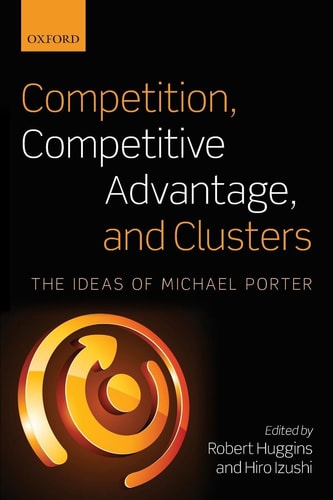
Competition, Competitive Advantage, and Clusters: The Ideas of Michael Porter
0
0
As an Amazon Associate and affiliate partner, Menrva Books earns from qualifying purchases. Learn more
Author Description
Harvard professor, Michael Porter has been one of the most influential figures in strategic management research over the last three decades. He infused a rigorous theoretical framework of industrial organization economics with the then still embryonic field of strategic management and elevated it to its current status as an academic discipline. Porter's outstanding career is also characterized by its cross-disciplinary nature. Following his most important work on strategic management, he then made a leap to the policy side and dealt with a completely different set of analytical units. More recently he has made a foray into inner city development, environmental regulations, and health care services. Throughout these explorations Porter has maintained his integrative approach, seeking a road that links management case studies and the general model building of mainstream economics.With expert contributors from a range of disciplines including strategic management, economic development, economic geography, and planning, this book assesses the contribution Michael Porter has made to these respective disciplines. It clarifies the sources of tension and controversy relating to all the major strands of Porter's work, and provides academics, students, and practitioners with a critical guide for the application of Porter's models. The book highlights that while many of the criticisms of Porter's ideas are valid, they are almost an inevitable outcome for a scholar who has sought to build bridges across wide disciplinary valleys. His work has provided others with a set of frameworks to explore in more depth the nature of competition, competitive advantage, and clusters from a range of vantage points.
Menrva's Summary
THE THESIS
This book investigates the enduring influence and theoretical validity of Michael Porter’s frameworks regarding competition, competitive advantage, and industrial clusters. The authors, Hiro Izushi and Robert Huggins, assemble a multidisciplinary team of experts to evaluate how Porter’s work has shaped strategic management, economic geography, and public policy. By bridging the gap between mainstream economic modeling and practical management case studies, the text provides a critical assessment of both the utility and the limitations of Porter’s models in contemporary academic and professional settings.
THE SCOPE MAP
What You Will Find
- A comprehensive analysis of Porter’s contributions to strategic management and industrial organization economics.
- Critical evaluations of Porter’s work on inner-city development, environmental regulation, and health care services.
- Scholarly perspectives from fields including economic geography, urban planning, and management theory.
- A balanced assessment of the controversies and tensions inherent in applying Porter’s models across diverse disciplinary boundaries.
THE AUTHORITY PERSPECTIVE
Experts and academics recognize this text as a necessary companion for those applying Porter’s models in research or practice. Readers frequently note the academic density of the prose, which serves as a rigorous guide for navigating the complexities of Porter's cross-disciplinary influence.
Page Count:
328
Publication Date:
2012-11-17
Publisher:
Oxford University Press
ISBN-10:
0199660425
ISBN-13:
9780199660421
Economics
Business
Academic
Strategic Planning
Community Tags
Similar Books