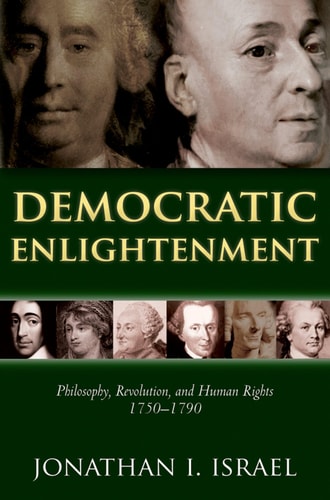
Democratic Enlightenment: Philosophy, Revolution, and Human Rights, 1750-1790
0
0
As an Amazon Associate and affiliate partner, Menrva Books earns from qualifying purchases. Learn more
Author Description
That the Enlightenment shaped modernity is uncontested. Yet remarkably few historians or philosophers have attempted to trace the process of ideas from the political and social turmoil of the late eighteenth century to the present day. This is precisely what Jonathan Israel now does.In Democratic Enlightenment, Israel demonstrates that the Enlightenment was an essentially revolutionary process, driven by philosophical debate. The American Revolution and its concerns certainly acted as a major factor in the intellectual ferment that shaped the wider upheaval that followed, but the radical philosophes were no less critical than enthusiastic about the American model. From 1789, the General Revolution's impetus came from a small group of philosophe-revolutionnaires, men such as Mirabeau, Sieyes, Condorcet, Volney, Roederer, and Brissot. Not aligned to any of the social groups represented in the French National assembly, they nonetheless forged "la philosophie moderne"-in effect Radical Enlightenment ideas-into a world-transforming ideology that had a lasting impact in Latin America, Canada and Eastern Europe as well as France, Italy, Germany, and the Low Countries. In addition, Israel argues that while all French revolutionary journals powerfully affirmed that la philosophie moderne was the main cause of the French Revolution, the main stream of historical thought has failed to grasp what this implies. Israel sets the record straight, demonstrating the true nature of the engine that drove the Revolution, and the intimate links between the radical wing of the Enlightenment and the anti-Robespierriste "Revolution of reason."
Menrva's Summary
THE THESIS
This work investigates the core question of how radical philosophical ideas functioned as the primary engine for the political and social transformations of the late eighteenth century. Jonathan Israel, a prominent historian of the Enlightenment, utilizes extensive archival research and analysis of contemporary revolutionary journals to challenge traditional historiography. He argues that the Enlightenment was not merely a cultural shift but a revolutionary process driven by a specific group of thinkers who sought to implement a coherent, world-transforming ideology of human rights and democracy.
THE SCOPE MAP
What You Will Find
- A detailed examination of the intellectual origins of the American and French Revolutions between 1750 and 1790.
- Analysis of the influence of radical philosophes such as Mirabeau, Sieyes, and Condorcet on global political structures.
- Evidence drawn from primary source revolutionary journals and contemporary political debates.
- A framework for understanding the transition from philosophical theory to the practical implementation of democratic rights in Europe and the Americas.
THE AUTHORITY PERSPECTIVE
Scholars frequently note the immense academic density and rigorous detail of Israel's prose, which demands significant prior knowledge of eighteenth-century political history. Experts highlight this text as a foundational, albeit challenging, contribution to the study of the Radical Enlightenment and its lasting impact on modern governance.
Page Count:
1088
Publication Date:
2013-02-07
Publisher:
Oxford University Press
ISBN-10:
0199668094
ISBN-13:
9780199668090
Philosophy
History
Enlightenment
European History
Europe
French Revolution
Intellectual History
Community Tags
Similar Books