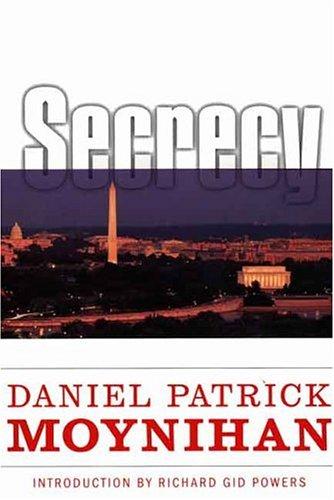
Secrecy
0
0
As an Amazon Associate and affiliate partner, Menrva Books earns from qualifying purchases. Learn more
Author Description
Senator Daniel Patrick Moynihan, chairman of the bipartisan Commission on Protecting and Reducing Government Secrecy, here presents an eloquent and fascinating account of the development of secrecy as a mode of regulation in American government since World War I - how it was born, how world events shaped it, how it has adversely affected momentous political decisions and events, and how it has eluded efforts to curtail or end it. Senator Moynihan begins with the intriguing story of the Venona project, the Soviet spy cables intercepted during World War II and decrypted by the U.S. Army - but never passed on to President Truman. The divisive Hiss perjury trial and the McCarthy era of suspicion might have had a far different impact on American society, says Moynihan, if government agencies had not kept secrets from one another as a means of shoring up their power. He discusses the Bay of Pigs, Watergate, the Iran-Contra affair, and, finally, the failure to forecast the collapse of the Soviet Union, suggesting the many of the tragedies resulting from these events could have been averted had the issues been clarified in an open exchange of ideas.
Menrva's Summary
THE THESIS
The development of government secrecy in the United States since World War I is examined, tracing its origins, its impact on critical political decisions, and the persistent challenges in controlling it. Senator Daniel Patrick Moynihan, drawing on his experience as chairman of the Commission on Protecting and Reducing Government Secrecy, details how secrecy evolved as a regulatory tool. He analyzes key historical events such as the Venona project, the Hiss perjury trial, the McCarthy era, the Bay of Pigs, Watergate, and the Iran-Contra affair, arguing that a lack of open information exchange among agencies exacerbated these crises and contributed to significant political missteps, including the failure to predict the Soviet Union's collapse.
THE SCOPE MAP
- An account of the evolution of government secrecy in the U.S. since World War I.
- Analysis of how secrecy has shaped momentous political decisions and events.
- Discussion of the Venona project and its implications.
- Examination of the role of secrecy in the Hiss perjury trial and the McCarthy era.
- Case studies including the Bay of Pigs, Watergate, and the Iran-Contra affair.
- An argument for how greater openness could have averted certain political tragedies.
- Insights into the challenges of curtailing or ending government secrecy.
THE AUTHORITY PERSPECTIVE
The book is regarded as a significant historical and political analysis by a prominent figure in American government. Moynihan's firsthand perspective and deep understanding of the mechanisms of power lend considerable weight to his arguments about the detrimental effects of unchecked government secrecy. The work is noted for its detailed examination of pivotal moments in 20th-century American history, linking them through the common thread of classified information and inter-agency distrust. It serves as both a historical record and a cautionary tale about the balance between national security and democratic transparency.
Page Count:
262
Publication Date:
1998-01-01
ISBN-10:
0300077564
Science
History
Politics
Non-Fiction
Espionage
Government
Community Tags
Similar Books