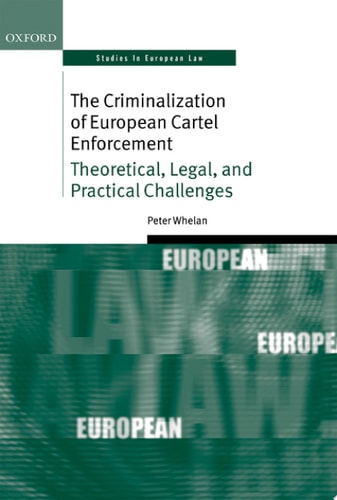
The Criminalization of European Cartel Enforcement: Theoretical, Legal, and Practical Challenges
0
0
As an Amazon Associate and affiliate partner, Menrva Books earns from qualifying purchases. Learn more
Author Description
Cartel activity is prohibited under EU law by virtue of Article 101(1) of the Treaty on the Functioning of the European Union. Firms that violate this provision face severe punishment from those entities responsible for enforcing EU competition law: the European Commission, the national competition authorities, and the national courts. Stiff fines are regularly imposed on firms by these entities; such firm-focused punishment is an established feature of the antitrust enforcement landscape within the EU. In recent years, however, focus has also been placed on the individuals within the firms responsible for the cartel activity. It is increasingly recognized that punishment for cartel activity should be individual-focused as well as firm-focused. Accordingly, a growing tendency to criminalize cartel activity can be observed in the EU Member States.The existence of such criminal sanctions within the EU presents a number of crucial challenges that need to be met if the underlying enforcement objectives are to be achieved in practice without violating prevailing legal norms. For a start, given the severe consequences of a custodial sentence, the employment of criminal antitrust punishment must be justifiable in principle: one must have a robust normative framework rationalizing the existence of criminal cartel sanctions. Second, for it to be legitimate, antitrust criminalization should only occur in a manner that respects the mandatory legalities applicable to the European jurisdiction in question. These include the due process rights of the accused and the principle of legal certainty. Finally, the correct practical measures (such as a criminal leniency policy and a correctly defined criminal cartel offence) need to be in place in order to ensure that the employment of criminal antitrust punishment actually achieves its aims while maintaining its legitimacy.These three particular challenges can be conceptualized respectively as the theoretical, legal, and practical challenges.
Menrva's Summary
THE THESIS
This book investigates whether the criminalization of cartel activity within the European Union can be justified and implemented without violating fundamental legal norms. Peter Whelan, a specialist in competition law, examines the shift from firm-focused sanctions to individual-focused criminal penalties. He provides a rigorous framework for evaluating the normative, legal, and practical requirements necessary to maintain legitimacy in antitrust enforcement across EU Member States.
THE SCOPE MAP
What You Will Find
- A normative analysis of the justification for custodial sentences in antitrust cases.
- An evaluation of due process rights and the principle of legal certainty within European jurisdictions.
- A critique of practical enforcement mechanisms, including criminal leniency policies and the definition of criminal cartel offenses.
- A comparative study of enforcement strategies employed by the European Commission and national competition authorities.
THE AUTHORITY PERSPECTIVE
Legal scholars and practitioners identify this work as a foundational text for understanding the intersection of criminal law and competition policy in Europe. Experts frequently highlight the author's balanced approach to the complex challenges of balancing effective deterrence with the protection of individual rights.
Page Count:
365
Publication Date:
2014-10-07
Publisher:
Oxford University Press
ISBN-10:
0199670064
ISBN-13:
9780199670062
Cartels
Competition Law
European Law
Professional Career & Trade
Antitrust Law
Criminology
Law
Community Tags
Similar Books