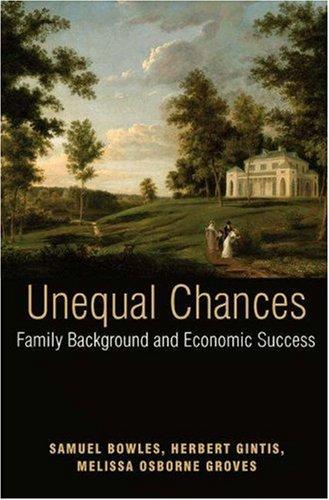
Unequal Chances
0
0
As an Amazon Associate and affiliate partner, Menrva Books earns from qualifying purchases. Learn more
Author Description
"Is the United States "the land of equal opportunity" or is the playing field tilted in favor of those whose parents are wealthy, well educated, and white? If family background is important in getting ahead, why? And if the processes that transmit economic status from parent to child are unfair, could public policy address the problem? Unequal Chances provides new answers to these questions by leading economists, sociologists, biologists, behavioral geneticists, and philosophers. "New estimates show that intergenerational inequality in the United States is far greater than was previously thought. Moreover, while the inheritance of wealth and the better schooling typically enjoyed by the children of the well-to-do contribute to this process, these two standard explanations fail to explain the extent of intergenerational status transmission. The genetic inheritance of IQ is even less important. Instead, parent-offspring similarities in personality and behavior may play an important role. Race contributes to the process, and the intergenerational mobility patterns of African Americans and European Americans differ substantially."--Jacket.
Menrva's Summary
THE THESIS
The United States's claim to be a land of equal opportunity is challenged by new evidence revealing significantly greater intergenerational inequality than previously understood. While parental wealth and superior schooling contribute, they do not fully account for the transmission of economic status. The book explores the roles of genetic inheritance, personality, behavior, and race in perpetuating these disparities, drawing on insights from a multidisciplinary group of experts.
THE SCOPE MAP
- New estimates of intergenerational inequality in the United States.
- Analysis of the roles of wealth inheritance and schooling in status transmission.
- Exploration of the impact of personality and behavior on economic mobility.
- Examination of racial disparities in intergenerational mobility patterns.
- Contributions from economists, sociologists, biologists, behavioral geneticists, and philosophers.
THE AUTHORITY PERSPECTIVE
This book presents a comprehensive, multidisciplinary examination of economic inequality in the United States, challenging conventional explanations for intergenerational status transmission. The collected essays offer novel insights into the roles of personality, behavior, and race, suggesting that these factors are more significant than previously acknowledged. The work aims to provide a deeper understanding of the processes that perpetuate inequality and to inform potential public policy interventions.
Page Count:
304
Publication Date:
2005-01-01
ISBN-10:
0691119309
ISBN-13:
9780691119304
Economics
Politics
Non-Fiction
Sociology
American Studies
Community Tags
Similar Books