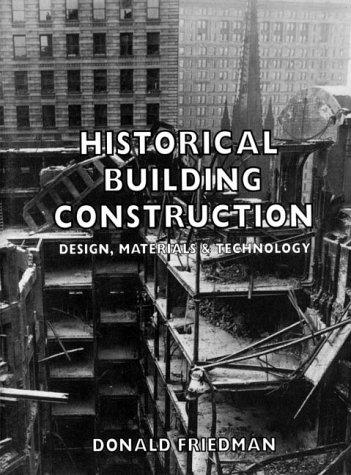
Historical Building Construction
0
0
As an Amazon Associate and affiliate partner, Menrva Books earns from qualifying purchases. Learn more
Author Description
A guide to the physical construction of buildings from the 1840s to the present, Historical Building Construction uses narrative, drawings, and photographs to describe the development of masonry, wood, and steel construction, modern curtain walls and concrete slabs, and the use of cast iron and patented floor construction. It provides case histories to show how this information is applied to actual projects, ranging from brownstones to skyscrapers. In order to show a consistent and well-documented set of examples evolving in chronological order, New York City is used as model, since many examples of obsolete forms are still available for examination. The general information given applies, with few exceptions, to buildings of the same types built all over the United States during the same period, and these are referenced as needed. Every designer who works on old structures or studies them will find in Historical Building Construction help in the process of analyzing existing conditions in a building and suggestions for dealing with what lies hidden behind floor, wall, and ceiling finishes.
Menrva's Summary
THE THESIS
This book details the evolution of building construction techniques from the mid-19th century to the present day. Donald J. Friedman's work examines the development of masonry, wood, and steel construction, alongside modern innovations like curtain walls and concrete slabs. It utilizes narrative, drawings, and photographs to illustrate these changes, supported by case histories that demonstrate their application in projects from brownstones to skyscrapers. New York City serves as a primary model for its chronological examples, though the principles discussed are applicable nationwide.
THE SCOPE MAP
- Development of masonry, wood, and steel construction techniques.
- Evolution of modern curtain walls and concrete slabs.
- Use of cast iron and patented floor construction methods.
- Case histories illustrating application in various building types (brownstones to skyscrapers).
- Chronological examples primarily drawn from New York City.
- Information applicable to buildings constructed across the United States.
- Guidance for analyzing existing conditions in older structures.
- Suggestions for dealing with hidden elements behind finishes in historical buildings.
THE AUTHORITY PERSPECTIVE
The subject matter points to a dense, specialist text aimed at architects, engineers, and preservationists working with historical structures. The detailed approach, utilizing case studies and visual aids, suggests a practical reference for understanding and addressing the complexities of older buildings. Its focus on New York City as a model provides a concrete framework for analyzing construction evolution. The book is positioned as a valuable resource for anyone involved in the study or renovation of historical architecture.
Page Count:
238
Publication Date:
1995-01-01
ISBN-10:
0393702006
ISBN-13:
9780393702002
History
Architecture
Non-Fiction
Building Technology
Construction
Community Tags
Similar Books