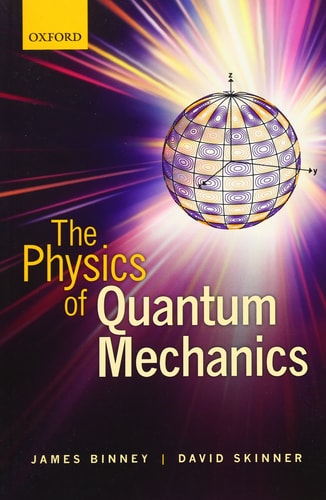
The Physics of Quantum Mechanics
0
0
As an Amazon Associate and affiliate partner, Menrva Books earns from qualifying purchases. Learn more
Author Description
The Physics of Quantum Mechanics aims to give students a good understanding of how quantum mechanics describes the material world. It shows that the theory follows naturally from the use of probability amplitudes to derive probabilities. It stresses that stationary states are unphysical mathematical abstractions that enable us to solve the theory's governing equation, the time-dependent Schroedinger equation. Every opportunity is taken to illustrate the emergence of the familiar classical, dynamical world through the quantum interference of stationary states. The text stresses the continuity between the quantum world and the classical world, which is merely an approximation to the quantum world.The connections between observables, operators and transformations are clearly explained and the standard commutation rules derived from the properties of spacetime. A chapter is devoted to entanglement, quantum computation, density operators and their role in thermodynamics, and the measurement problem. Scattering phenomena, including the origin of radioactivity, are handled early on in the accessible context of one dimension, and at the end of the book with some rigour in three dimensions. Hydrogen and helium are discussed in some detail and it is shown that quantum mechanics enables us to understand the structure of the periodic table without engaging with the complexities of many-electron atoms.Dirac notation is used from the outset and students are trained to move easily from one representation to another, choosing whichever representation is best suited to a particular problem. The mathematical prerequisites are no more than simple vector algebra, Taylor series expansion and the use of integrating factors to solve linear first order differential equations. Rigorous algebraic methods are preferred to the solution of partial differential equations.To request a copy of the Solutions Manual, visit: http://global.oup.com/uk/academic/physics/admin/solutions
Menrva's Summary
THE THESIS
This text investigates the fundamental principles of quantum mechanics by demonstrating how the theory emerges from probability amplitudes and the time-dependent Schroedinger equation. James Binney, a distinguished physicist, provides a pedagogical framework that prioritizes algebraic methods over complex partial differential equations. The book argues that the classical world is an approximation of quantum reality, utilizing a structured approach to bridge the gap between abstract mathematical formalism and observable physical phenomena.
THE SCOPE MAP
What You Will Find
- Comprehensive introduction to Dirac notation and representation shifting
- Analysis of stationary states, observables, operators, and spacetime transformations
- Detailed examination of entanglement, quantum computation, and density operators
- Practical applications including scattering phenomena, radioactivity, and atomic structure
THE AUTHORITY PERSPECTIVE
Experts and educators frequently highlight this text for its accessible yet rigorous approach to quantum theory, particularly its emphasis on algebraic clarity. Students and researchers often note that the book serves as a foundational resource for understanding the transition from quantum mechanics to classical approximations.
Page Count:
412
Publication Date:
2013-12-31
Publisher:
Oxford University Press
ISBN-10:
0199688575
ISBN-13:
9780199688579
Science
Art
Academic
Physics
textbook
Community Tags
Similar Books






![Instructor's resource manual to accompany Biology, 3nd edition [by] Karen Arms, Pamela S. Camp](https://storage.googleapis.com/menrva_img_storage/covers/generated/9780030036477.jpg)