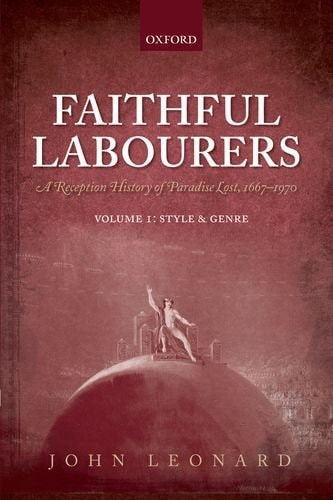
Faithful Labourers: A Reception History of Paradise Lost, 1667-1970
Author Description
Faithful Labourers surveys and evaluates existing criticism of John Milton's epic Paradise Lost, tracing the major debates as they have unfolded over the past three centuries. Eleven chapters split over two volumes consider the key debates in Milton criticism, including discussion of Milton'sstyle, his use of the epic genre, and his references to Satan, God, innocence, the fall, sex, nakedness, and astronomy.Volume one attends to questions of style and genre. The first three chapters examine the longstanding debate about Milton's grand style and the question of whether it forfeits the native resources of English. Early critics saw Milton as the pre-eminent poet of 'apt Numbers' and 'fit quantity', whoseverse is 'apt' in the specific sense of achieving harmony between sound and sense; twentieth-century anti-Miltonists faulted Milton for divorcing sound from sense; late twentieth-century theorists have denied the possibility that sound can 'enact' sense. These are extreme changes of criticalperception, and yet the story of how they came about has never been told. These chronological chapters explain the roots of these changes and, in doing so, engage with the enduring theoretical question of whether it is possible for sound to enact sense.Volume two considers interpretative issues, and each of the six chapters traces a key debate in the interpretation of Paradise Lost. They engage with such questions as whether Paradise Lost is an epic or an anti-epic, whether Satan runs away with the poem (and whether it is good that he does so),what it means to be innocent (or fallen), and whether Milton's poetry is hostile to women. A final chapter on the universe of Paradise Lost makes the provocative argument that almost every commentator since the middle of the eighteenth century has led readers astray by presenting Milton's universeas the medieval model of Ptolemaic spheres. This assumption, which has fostered the notion that Milton was backward-looking or anti-intellectual, re
Menrva's Summary
THE THESIS
This work investigates the evolution of critical reception surrounding John Milton's epic poem, Paradise Lost, from its initial publication in 1667 through 1970. John A. Leonard, an established scholar in Miltonic studies, synthesizes three centuries of commentary to map how shifting intellectual paradigms have altered the interpretation of Milton's style, theology, and cosmology. By analyzing the trajectory of major debates, the author argues that historical critical perspectives have often been misaligned with the poet's original intent, particularly regarding the poem's scientific and structural foundations.
THE SCOPE MAP
What You Will Find
- A comprehensive chronological survey of Miltonic criticism spanning over three hundred years.
- Analysis of the debate regarding the relationship between sound and sense in Milton's verse.
- Examination of thematic controversies including the characterization of Satan, the nature of innocence, and gender dynamics within the text.
- A critical reassessment of the Ptolemaic model and its influence on modern interpretations of the poem's universe.
THE AUTHORITY PERSPECTIVE
Scholars and students of seventeenth-century literature frequently cite this work as a foundational resource for understanding the history of Miltonic scholarship. Readers often note the academic density of the prose, which serves as a rigorous reference for those tracking the development of literary theory over the centuries.
Page Count:
853
Publication Date:
2013-01-01
Publisher:
Oxford University Press, USA
ISBN-10:
0199681805
ISBN-13:
9780199681808
Poetry
History
English literature
Literary Criticism
Subjects
Academic
Community Tags
Similar Books