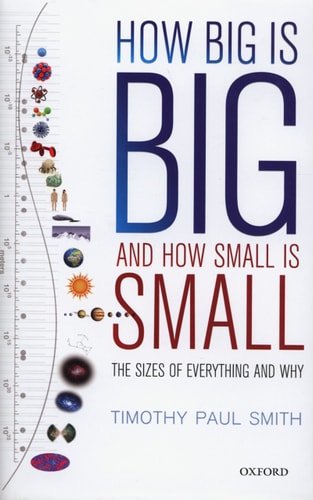
How Big is Big and How Small is Small: The Sizes of Everything and Why
0
0
As an Amazon Associate and affiliate partner, Menrva Books earns from qualifying purchases. Learn more
Author Description
This book is about how big is the universe and how small are quarks, and what are the sizes of dozens of things between these two extremes. It describes the sizes of atoms and planets, quarks and galaxies, cells and sequoias. It is a romp through forty-five orders of magnitude from the smallest sub-nuclear particles we have measured, to the edge of the observed universe. It also looks at time, from the epic age of the cosmos to the fleeting lifetimes of ethereal particles. It is a narrative that trips its way from stellar magnitudes to the clocks on GPS satellites, from the nearly logarithmic scales of a piano keyboard through a system of numbers invented by Archimedes and on to the measurement of the size of an atom.Why do some things happen at certain scales? Why are cells a hundred thousandths of a meter across? Why are stars never smaller than about 100 million meters in diameter? Why are trees limited to about 120 meters in height? Why are planets spherical, but asteroids not? Often the size of an object is determined by something simple but quite unexpected. The size of a cell and a star depend in part on the ratio of surface area to volume. The divide between the size of a spherical planet and an irregular asteroid is the balance point between the gravitational forces and the chemical forces in nature.Most importantly, with a very few basic principles, it all makes sense. The world really is a most reasonable place.
Menrva's Summary
THE THESIS
This book investigates the physical constraints that dictate the size and scale of objects across the universe, from subatomic particles to galactic structures. Timothy Paul Smith, a physicist, utilizes a framework of forty-five orders of magnitude to explain why objects in nature exist within specific size ranges. By applying fundamental principles of physics, such as the ratio of surface area to volume and the interplay between gravitational and chemical forces, the author demonstrates that the dimensions of the natural world are not arbitrary but are governed by logical, predictable laws.
THE SCOPE MAP
What You Will Find
- A comprehensive survey of objects spanning forty-five orders of magnitude, including quarks, atoms, cells, trees, planets, and galaxies.
- An examination of temporal scales, comparing the lifespan of subatomic particles to the age of the cosmos.
- Explanations of physical constants and forces that limit the growth of biological and astronomical entities.
- Mathematical and conceptual tools for understanding logarithmic scales and measurement systems.
THE AUTHORITY PERSPECTIVE
Readers frequently note the accessibility of the prose, which translates complex physical concepts into a format suitable for a general audience. Experts highlight this work as a clear, pedagogical resource for understanding the fundamental limits of physical reality.
Page Count:
264
Publication Date:
2014-02-01
Publisher:
Oxford University Press
ISBN-10:
0199681198
ISBN-13:
9780199681198
Science
Nature
Popular Science
Categories
Units of measurement
Kindle eBooks
Body Size
Philosophy history
Physics
Adaptation Biology
Time
SCIENCE Astronomy
Cosmology
Kindle Store
Community Tags
Similar Books