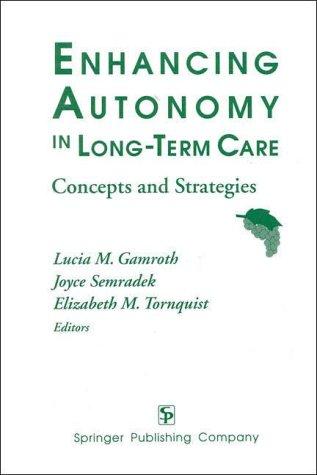
Enhancing Autonomy in Long-Term Care
0
0
As an Amazon Associate and affiliate partner, Menrva Books earns from qualifying purchases. Learn more
Author Description
This volume assesses the importance of autonomy to quality of life in long-term care facilities. First addressing conceptual issues, the editors then pose such questions as: What is autonomy and what does it mean in the context of physically and/or cognitively impaired elders? What is the effect of nursing home financing and federal regulations? How does the traditional medical model, which casts residents as "patients," affect autonomy? How does the physical environment make a difference? The contributors then go on to describe six successful models of care that provide a more meaningful quality of life through promoting autonomy. Contributors include Robert and Rosalie Kane, Keren Brown Wilson, and Bart Collopy.
Menrva's Summary
THE THESIS
This volume investigates the critical role of autonomy in ensuring a high quality of life for residents within long-term care facilities. It begins by exploring the fundamental concepts of autonomy, particularly as they apply to individuals with physical or cognitive impairments. The text then examines the influence of financial structures and federal regulations on resident autonomy, and critiques how the traditional patient-centric medical model may inadvertently diminish it. Finally, it presents six innovative care models that successfully enhance resident autonomy and improve their overall quality of life.
THE SCOPE MAP
- Exploration of the conceptual definition of autonomy for impaired elders.
- Analysis of the impact of nursing home financing and federal regulations.
- Critique of the traditional medical model's effect on resident autonomy.
- Examination of how the physical environment influences autonomy.
- Presentation of six successful models for promoting autonomy in care.
- Contributions from notable experts in gerontology and long-term care.
THE AUTHORITY PERSPECTIVE
The book is structured to provide a comprehensive examination of autonomy in long-term care, moving from theoretical underpinnings to practical applications. Its focus on specific care models suggests an intent to offer actionable insights for administrators and caregivers. The inclusion of established contributors indicates a foundation in expert discourse within the field of gerontology.
Page Count:
244
Publication Date:
1995-01-01
ISBN-10:
0826186807
ISBN-13:
9780826186805
Psychology
Non-Fiction
Health
Gerontology
Healthcare Administration
Quality of Life
Community Tags
Similar Books