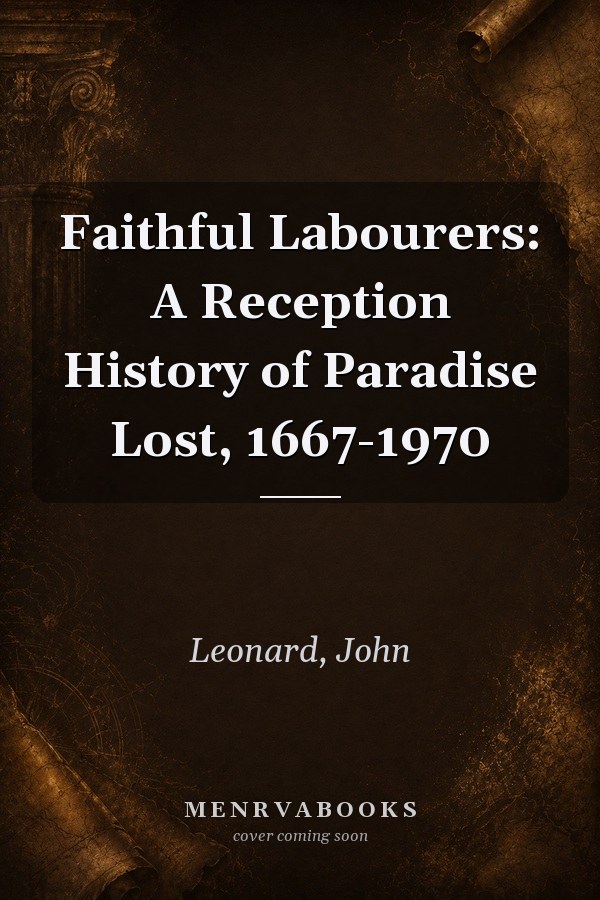
Faithful Labourers: A Reception History of Paradise Lost, 1667-1970
0
0
As an Amazon Associate and affiliate partner, Menrva Books earns from qualifying purchases. Learn more
Author Description
Volume one attends to questions of style and genre. The first three chapters examine the longstanding debate about Milton's grand style and the question of whether it forfeits the native resources of English. Early critics saw Milton as the pre-eminent poet of 'apt Numbers' and 'fit quantity', whose verse is 'apt' in the specific sense of achieving harmony between sound and sense; twentieth-century anti-Miltonists faulted Milton for divorcing sound from sense; late twentieth-century theorists have denied the possibility that sound can 'enact' sense. These are extreme changes of critical perception, and yet the story of how they came about has never been told. These chronological chapters explain the roots of these changes and, in doing so, engage with the enduring theoretical question of whether it is possible for sound to enact sense. Volume two considers interpretative issues, and each of the six chapters traces a key debate in the interpretation of Paradise Lost. They engage with such questions as whether Paradise Lost is an epic or an anti-epic, whether Satan runs away with the poem (and whether it is good that he does so), what it means to be innocent (or fallen), and whether Milton's poetry is hostile to women. A final chapter on the universe of Paradise Lost makes the provocative argument that almost every commentator since the middle of the eighteenth century has led readers astray by presenting Milton's universe as the medieval model of Ptolemaic spheres. This assumption, which has fostered the notion that Milton was backward-looking or anti-intellectual, rests upon a misreading of three satirical lines. Milton's earliest critics recognized that he unequivocally embraces the new astronomy of Kepler and Bruno.
Menrva's Summary
THE THESIS
*This work investigates the shifting critical reception of John Milton's Paradise Lost from its publication in 1667 through 1970, questioning how evolving theoretical frameworks have altered the interpretation of the poem's style and substance.* John Leonard, a scholar of Miltonic studies, utilizes a comprehensive chronological approach to analyze how generations of critics have perceived the epic's verse, its theological implications, and its cosmological structure. By contrasting early assessments of Milton's 'apt numbers' with twentieth-century critiques, the author exposes the historical roots of modern interpretive disagreements. The text argues that many long-held assumptions about Milton's work, particularly regarding his astronomical model, stem from persistent misreadings rather than the text itself.
THE SCOPE MAP
What You Will Find
- A detailed analysis of the debate surrounding Milton's grand style and the relationship between sound and sense.
- An examination of major interpretative conflicts, including the characterization of Satan and the poem's stance on gender.
- A historical survey of critical reception spanning over three centuries of literary scholarship.
- A re-evaluation of the cosmological model in Paradise Lost, challenging the traditional view that Milton relied on Ptolemaic spheres.
THE AUTHORITY PERSPECTIVE
Scholars recognize this work as a rigorous and essential contribution to Miltonic studies, particularly for its meticulous tracing of critical trends. Readers frequently note the academic density of the prose, which serves as a foundational resource for those studying the history of literary theory and the reception of epic poetry.
Page Count:
853
Publication Date:
2013-01-01
Publisher:
Oxford University Press
ISBN-10:
0199681813
ISBN-13:
9780199681815
Poetry
History
Non-Fiction
Literary Criticism
Academic
Community Tags
Similar Books