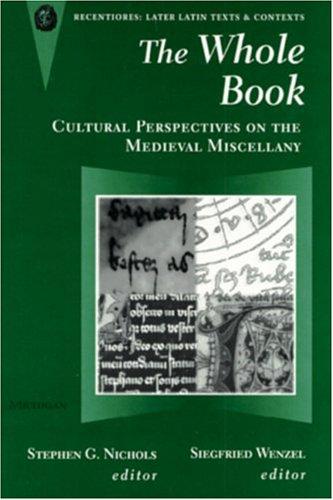
The Whole Book
0
0
As an Amazon Associate and affiliate partner, Menrva Books earns from qualifying purchases. Learn more
Author Description
Before the computer, even before the printed book, medieval manuscripts used hypertext in organizing space that was naturally interdisciplinary. The Whole Book, edited by Stephen G. Nichols and Siegfried Wenzel, assembles findings from a diverse group of well-respected medievalists, classicists, and text critics. Their many areas of research have intersected in this study of how medieval manuscripts developed mechanisms for using the available space in the technologies of the codex, which we now know as the book. The scholars presented here, whose own fields of study range from Latin religious texts to vernacular romance, comment on one particular category of manuscript, the "miscellany." This genre of manuscript had the ability to accommodate a wide variety of written documents, making it difficult to classify.. The term miscellany has traditionally been used, for want of a better term, but such a collection could very well be described as the "hard disk" of the medieval codex: it was a space on which almost any kind of information could be stored in a variety of formats - texts, pictures, designs, symbols, etc. Like the hard disk of a computer, it offered a seemingly vast, though of course in fact limited, space for recording items. It furthermore inspired numerous ways of organizing, distributing, and codifying the information to facilitate retrieval. The Whole Book deals with manuscripts from the early Middle Ages to humanist works of the early Renaissance, and it presents the conditions of production and analyzes the organizational techniques in particular kinds of miscellanies.
Menrva's Summary
THE THESIS
The Whole Book investigates the organizational and spatial technologies of medieval manuscripts, particularly the 'miscellany' genre, as precursors to modern hypertext. This collection, edited by Stephen G. Nichols and Siegfried Wenzel, draws on the expertise of medievalists, classicists, and text critics to explore how these manuscripts utilized the codex format to store diverse information. The scholars examine the conditions of production and the organizational techniques employed in these manuscripts, which served as the 'hard disk' of their time, accommodating texts, images, and symbols. The study spans from the early Middle Ages to the early Renaissance, analyzing the methods used for organizing, distributing, and retrieving information within these complex textual artifacts.
THE SCOPE MAP
- Analysis of hypertextual organization in medieval manuscripts.
- Exploration of the 'miscellany' genre as a storage medium.
- Contributions from diverse scholars in medieval studies, classics, and text criticism.
- Examination of the codex as a technological space for information.
- Discussion of manuscript production conditions from the early Middle Ages to the early Renaissance.
- Analysis of organizational techniques for information retrieval in miscellanies.
- Comparison of medieval manuscript space to modern computer hard disks.
THE AUTHORITY PERSPECTIVE
This scholarly collection is recognized for its interdisciplinary approach, bringing together experts to analyze the sophisticated organizational strategies within medieval manuscripts. The concept of the 'miscellany' as a precursor to modern digital information storage is a key focus, highlighting the ingenuity of medieval scribes and scholars. The book is valued for its detailed examination of manuscript production and the techniques used to manage diverse content, offering insights into the intellectual life of the period. Its scope, covering a broad historical range from the early Middle Ages to the Renaissance, makes it a significant resource for understanding the evolution of the book.
Page Count:
200
Publication Date:
1997-01-01
ISBN-10:
0472106961
ISBN-13:
9780472106967
History
Non-Fiction
Miscellany
Community Tags
Similar Books