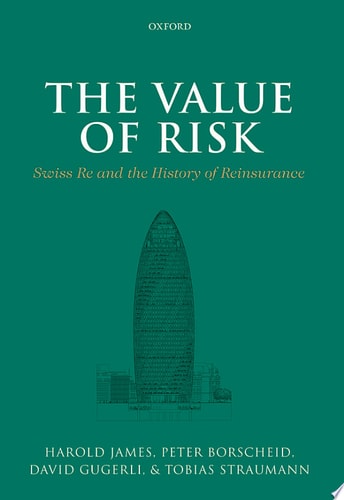
The Value of Risk: Swiss Re and the History of Reinsurance
0
0
As an Amazon Associate and affiliate partner, Menrva Books earns from qualifying purchases. Learn more
Author Description
Reinsurance is an invisible service industry which enables insurance companies to insure more risks and to make better use of their resources. Until recently, reinsurers were only known to a small minority outside the insurance community. Major disasters, especially those caused by natural catastrophes, have increasingly brought the industry into the spotlight. Yet what is perceived today by a wider public still only represents a fraction of the industry, and the mechanisms of reinsurance to deal with global risk exposure are virtually unknown. The Value of Risk provides an overview of how today's reinsurance industry developed. It investigates for the first time the role of reinsurers in a changing risk, economic, and market environment.Harold James explains the fundamental principles of insuring and outlines the evolution of the industry in his introductory essay. In Part I, Peter Borscheid describes in detail the global spread of modern insurance, which emerged in the late eighteenth century amidst ideas of rationalism which attempted to quantify risk in monetary terms, the setbacks it encountered, and how the market environment changed over time. Professional reinsurance emerged with the rise in insured risks in the industrialising mid-nineteenth century. By the time the San Francisco Earthquake happened in 1906 the reinsurance industry had become well established and showed a remarkable ability to deal collectively with the catastrophe. David Gugerli describes in Part II how the industry as a whole dealt with such challenges but also the numerous exposures to a changing risk landscape. Against this background, in Part III Tobias Straumann examines the history of the Swiss Reinsurance Company, founded in 1863, providing a fascinating example of how professional risk taking was developed over the last 150 years.
Menrva's Summary
THE THESIS
This book investigates the historical development of the global reinsurance industry and its critical function in managing systemic economic risk. The authors, a team of distinguished historians and economists including Harold James, utilize archival records and corporate history to trace how the quantification of risk evolved from the mid-nineteenth century to the present. By examining the specific trajectory of the Swiss Reinsurance Company, the text argues that reinsurance serves as a foundational mechanism for industrial stability and global market expansion.
THE SCOPE MAP
What You Will Find
- A detailed historical analysis of the insurance industry from the late eighteenth century to the modern era.
- An examination of how major natural catastrophes, such as the 1906 San Francisco Earthquake, shaped industry standards.
- A comprehensive case study of the Swiss Reinsurance Company spanning 150 years of operations.
- Theoretical frameworks regarding the rationalization and monetary quantification of global risk.
THE AUTHORITY PERSPECTIVE
Experts recognize this work as a definitive corporate history that bridges the gap between specialized financial practice and broader economic history. Readers frequently note the academic density of the prose, which provides a rigorous examination of institutional risk management for scholars and industry professionals alike.
Page Count:
464
Publication Date:
2014-02-19
Publisher:
Oxford University Press
ISBN-10:
0199689806
ISBN-13:
9780199689804
Business
History
Economics
Reinsurance
Corporate History
Finance
Community Tags
Similar Books














Reader Comments
Share Your Thoughts
No comments yet. Be the first to share your thoughts!