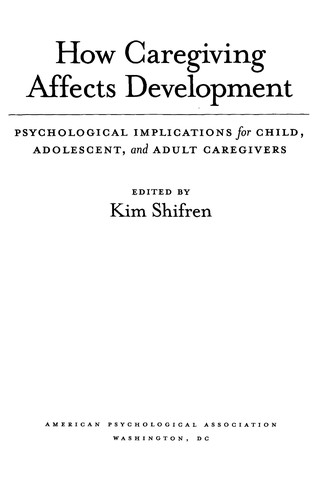
How Caregiving Affects Development
0
0
As an Amazon Associate and affiliate partner, Menrva Books earns from qualifying purchases. Learn more
Author Description
As recent advances in medicine contribute to people living longer and living with chronic illness in the home, the role of the family caregiver is becoming more common. Furthermore, because of varying family structures and living situations, it is not always the parent or adult child who takes on the caregiver role. The traditional role of the adult caregiver increasingly falls on the shoulders of children, adolescents, and emerging adults. In cases where parents are unable to take care of their children, grandparents take on the role of adult caregiver for their grandchildren. A caregiving role at any point in life may affect a person's development and add stressors but also may create rewards that influence the caregiver's identity and well-being. "How Caregiving Affects Development: Psychological Implications for Child, Adolescent, and Adult Caregivers" examines these effects using a life span development framework. Each chapter presents theory and empirical research on caregiving during a different phase in the life span, including childhood, adolescence, emerging adulthood, and young, middle, and older adulthood. Within the context of the caregiver's life, the chapter authors examine how the role of caregiver affects development.--Jacket.
Menrva's Summary
THE THESIS
The increasing prevalence of family caregiving across all age groups presents complex psychological implications for individual development. As medical advancements extend lifespans and chronic illnesses become more common, the responsibility of caregiving is shifting, often falling upon children, adolescents, and emerging adults, as well as grandparents. This book examines how assuming a caregiving role at any life stage can introduce stressors, shape identity, and offer unique rewards, influencing the caregiver's overall well-being and developmental trajectory.
THE SCOPE MAP
- Examination of caregiving effects across the entire lifespan, from childhood to older adulthood.
- Analysis of psychological implications for child, adolescent, and adult caregivers.
- Integration of theoretical frameworks and empirical research on caregiving.
- Discussion of how the caregiver role impacts identity, well-being, and developmental processes.
- Exploration of stressors and rewards associated with caregiving responsibilities.
- Consideration of diverse family structures and non-traditional caregiver roles.
THE AUTHORITY PERSPECTIVE
This book is structured as an academic examination of caregiving's impact on development, drawing on psychological theory and empirical research. The life-span framework suggests a comprehensive approach, covering various age groups and their unique experiences as caregivers. The focus on psychological implications indicates a depth of analysis intended for students, researchers, or professionals in psychology and social sciences. The book aims to provide a thorough understanding of how caregiving shapes individuals throughout their lives.
Page Count:
223
Publication Date:
2009-01-01
ISBN-10:
1433803933
ISBN-13:
9781433803932
Psychology
Non-Fiction
Developmental Psychology
Caregiving
Family Studies
Community Tags
Similar Books