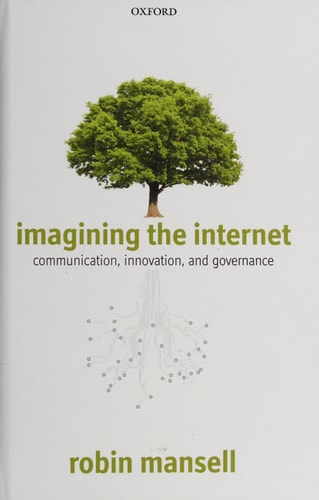
Imagining the Internet: Communication, Innovation, and Governance
0
0
As an Amazon Associate and affiliate partner, Menrva Books earns from qualifying purchases. Learn more
Author Description
This book is an impressive survey of our collective and cumulative understanding of the evolution of digital communication systems and the Internet. While the information societies of the twenty-first century will develop ever more sophisticated technologies, the Internet is now a familiar and pervasive part of the world in which we live, work, and communicate. As such it is important to take stock of some fundamental questions--whether, for example, it contributes to progress, social cohesion, democracy, and growth--and at the same time to review the rich and varied theories and perspectives developed by thinkers in a range of disciplines over the last fifty years or more.In this remarkably comprehensive but concise and useful book, Robin Mansell summarizes key debates, and reviews the contributions of major thinkers in communication systems, economics, politics, sociology, psychology, and systems theory--from Norbert Wiener to Brian Arthur and Manuel Castells, and from Gregory Bateson to William Davidow and Sherry Turkle. This is an interdisciplinary and critical analysis of the way we experience the Internet in front of the screen, and of the developments behind the screen, all of which have implications for privacy,security, intellectual property rights, and the overall governance of the Internet.The author presents fairly the ideas of the celebrants and the sceptics, and reminds us of the continuing need for careful, critical, and informed analysis of the paradoxes and challenges of the Internet, offering her own views on how we might move to greater empowerment, and suggesting policy measures and governance approaches that go beyond those commonly debated.This concise book will be essential reading for anyone who wants to understand the challenges the Internet presents in the twenty-first century, and the debates and research that can inform that understanding.
Menrva's Summary
THE THESIS
How does the evolution of the Internet and its associated digital communication systems influence our understanding of progress, democracy, and social cohesion in the twenty-first century? Robin Mansell, a professor specializing in new media and the Internet, synthesizes fifty years of interdisciplinary research to evaluate the paradoxes of digital connectivity. By examining theories from economics, sociology, and systems theory, she constructs a framework that balances the optimistic views of technological celebrants against the critical warnings of skeptics. The text argues for a more nuanced approach to governance that prioritizes individual empowerment and informed policy-making over simplistic technological determinism.
THE SCOPE MAP
What You Will Find
- A comprehensive review of theoretical contributions from thinkers including Norbert Wiener, Manuel Castells, and Sherry Turkle.
- An interdisciplinary analysis covering communication systems, economics, politics, and psychology.
- Examination of critical issues such as privacy, security, intellectual property rights, and digital governance.
- Proposed policy measures and governance strategies designed to address the challenges of the modern information society.
THE AUTHORITY PERSPECTIVE
Experts and academics recognize this work as a foundational synthesis of the diverse intellectual traditions that inform current Internet studies. Readers frequently note the clarity with which the author navigates complex interdisciplinary debates, making it a valuable resource for students and policy analysts alike.
Page Count:
296
Publication Date:
2012-09-08
Publisher:
Oxford University Press
ISBN-10:
0199697051
ISBN-13:
9780199697052
Information society
Internet
Governance
Technology
Communication
Sociology
Community Tags
Similar Books