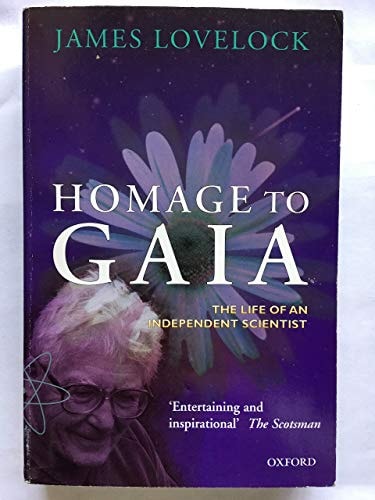
Homage to Gaia
0
0
As an Amazon Associate and affiliate partner, Menrva Books earns from qualifying purchases. Learn more
Author Description
James Lovelock tells the fascinating story of his life as an independent scientist and how he came to develop his inventions and theories. He has filed more than 50 patents, including one for the electron capture detector that was important in the development of environmental awareness, in connection with both the detection of pesticide residues in the environment and the discovery of the global distribution of CFCs. He also tells us about the work he has done for organizations such as NASA, the Ministry of Defence, The Marine Biological Association, and many companies such as Shell and Hewlett Packard. From his childhood days in east London to a job as a lab assistant - his first crucial steps to becoming a scientist, from chemistry at Manchester University to the Medical Research Council during World War II, his voyage to the Arctic, taking his family to America, returning to England and fighting to save the ozone layer, his quest for gaia, then into the nineties and a stream of awards, including a CBE from the Queen. James Lovelock has led a fulfilling life and has been widely recognized by the international scientific community.
Menrva's Summary
THE THESIS
This autobiography investigates the professional trajectory of James Lovelock, focusing on how his independent scientific approach led to the formulation of the Gaia hypothesis. Lovelock details his transition from a lab assistant to a prolific inventor holding over 50 patents, including the electron capture detector. He contextualizes his scientific contributions within his work for major institutions like NASA and the Ministry of Defence, arguing that independent inquiry is essential for environmental discovery. The narrative serves as both a personal history and a chronicle of the development of modern environmental awareness.
THE SCOPE MAP
What You Will Find
- A chronological account of Lovelock's career from his early days in east London to his recognition by the international scientific community.
- Technical insights into the development of the electron capture detector and its role in identifying CFCs.
- Primary source reflections on collaborations with organizations such as NASA, Shell, and the Medical Research Council.
- An exploration of the origins and evolution of the Gaia hypothesis within the context of 20th-century environmental science.
THE AUTHORITY PERSPECTIVE
Experts and readers recognize this work as a vital primary source for understanding the history of environmental science and the life of one of its most influential figures. The text is noted for its accessible prose, which effectively balances technical scientific achievement with the personal narrative of a self-directed researcher.
Page Count:
0
Publication Date:
2000-01-01
Publisher:
Oxford Univ Press
ISBN-10:
0199691096
ISBN-13:
9780199691098
Science
Autobiography
Biography
Environment
Subjects
Community Tags
Similar Books