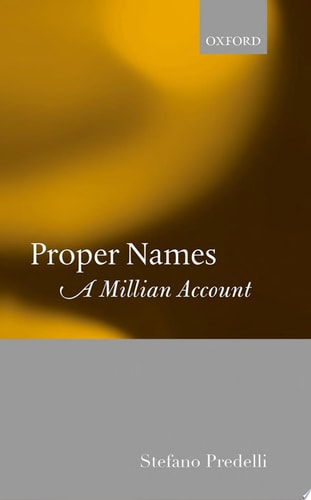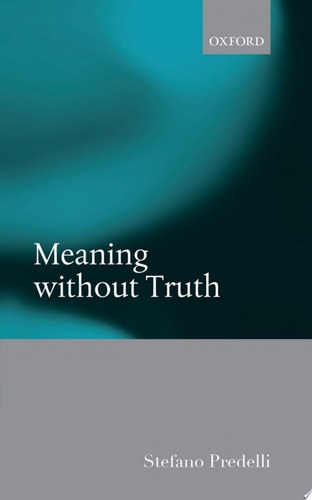
Meaning without Truth
0
0
As an Amazon Associate and affiliate partner, Menrva Books earns from qualifying purchases. Learn more
Author Description
Stefano Predelli presents an original account of the relationships between the central semantic notions of meaning and truth. Part One begins with the study of phenomena that have little or nothing to do with the effects of meaning on truth. Predelli warns against what he calls "the Fallacy of Misplaced Character," and is concerned with sentences such as "there sometimes exist sentences containing exactly eight words," "I am now uttering a non-contradictory sentence," or "I exist." In Part Two, he moves on to further cases which bear no interesting relations with questions of truth, but which, unlike those in Part One, have important repercussions on questions of meaning. The resulting "Theory of Bias" is applied to expressive interjections (with a chapter about the logical properties of "alas"), to instances of register and coarse slang, to honorifics and nicknames, and to derogatory slurs. Part Three draws from the previous two parts, and argues that some notorious semantic problems ought to be approached from the viewpoint of the Theory of Bias. Predelli starts with vocatives, dates, and signatures, and introduces the notion of "obstinate indexicality," which then guides his solution to Quine's "Giorgione" puzzle, his version of the demonstrative theory quotation, and his defence of the bare-boned approach to demonstratives and demonstrations.
Menrva's Summary
THE THESIS
This book investigates the complex relationship between semantic meaning and truth conditions, arguing that many linguistic expressions function independently of truth-evaluable content. Stefano Predelli, a philosopher specializing in the philosophy of language, utilizes a rigorous analytical framework to challenge traditional semantic assumptions. He introduces the 'Theory of Bias' to account for linguistic phenomena that influence meaning without contributing to the truth conditions of a sentence. By examining specific linguistic categories, he provides a systematic approach to resolving long-standing puzzles in formal semantics.
THE SCOPE MAP
What You Will Find
- An analysis of the 'Fallacy of Misplaced Character' regarding self-referential and existential sentences.
- The development of the 'Theory of Bias' to explain expressive interjections, honorifics, and derogatory slurs.
- A formal examination of register, slang, and the logical properties of expressive language.
- Applications of 'obstinate indexicality' to solve classic philosophical problems, including Quine's 'Giorgione' puzzle and demonstrative theory.
THE AUTHORITY PERSPECTIVE
Experts in the field of analytic philosophy recognize this work as a significant contribution to the study of indexicality and expressive meaning. Readers frequently note the technical density of the prose, which is intended for advanced students and scholars of formal semantics.
Page Count:
256
Publication Date:
2013-08-24
Publisher:
Oxford University Press
ISBN-10:
0199695636
ISBN-13:
9780199695638
Philosophy
Language
Linguistics
Logic
Literature
Semantics
Community Tags
Similar Books