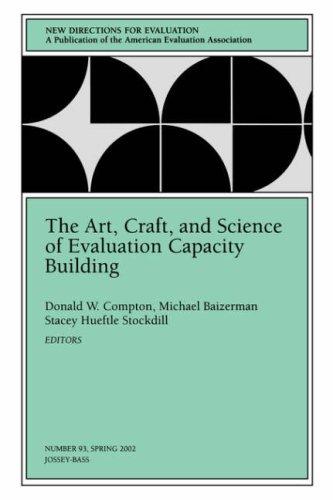
The Art, Craft, and Science of Evaluation Capacity Building
0
0
As an Amazon Associate and affiliate partner, Menrva Books earns from qualifying purchases. Learn more
Author Description
Evaluation Capacity Building (ECB) is now being given attention, but as yet there is only a small literature about this necessary and seemingly rare process. ECB is the often-invisible work carried out within or between organizations to sustain the evaluation unit and evaluation studies. It is the ongoing, everyday work necessary to ensure quality evaluation practice. It is the vision, the political and administrative effort and management craft which continues to make possible over time the organizational conditions in which professional evaluation work is completed and used, requested, carried out and used, ad infinitum. This issue of New Directions for Evaluation is given over to the conceptualization and illumination of the evaluation capacity building process. Four case studies written by contributors show the complexity of the ECB process and its variation in different organizational structures and environments. Included are a federal agency (The Center for Disease Control and Prevention), a nationwide voluntary health organization (The American Cancer Society), an international development agency (The World Bank), and a local school district (The Anoka-Hennepin School District [Minnesota]). The Editors introduce and define ECB, compare it to evaluation practice, and draw out ECB themes from the case studies. These sections are used to suggest a practical framework for understanding the core ECB elements, to develop a visible organizational ECB checklist, and to provide a conceptual model for theory building and the collection of ECB case studies.--Jacket.
Menrva's Summary
THE THESIS
This book addresses the often-invisible work of sustaining evaluation units and studies within organizations. The author, Donald W. Compton, introduces and defines Evaluation Capacity Building (ECB), distinguishing it from evaluation practice itself. The text explores the vision, political and administrative effort, and management craft required to foster an environment where professional evaluation work can be consistently completed and utilized.
THE SCOPE MAP
- Conceptualization and illumination of the evaluation capacity building process.
- Four detailed case studies from diverse organizations: a federal agency (CDC), a nationwide voluntary health organization (American Cancer Society), an international development agency (The World Bank), and a local school district (Anoka-Hennepin School District).
- Introduction and definition of ECB by the editors, comparing it to evaluation practice.
- Extraction of key ECB themes from the case studies.
- A practical framework for understanding core ECB elements.
- Development of a visible organizational ECB checklist.
- A conceptual model for theory building and the collection of ECB case studies.
THE AUTHORITY PERSPECTIVE
The book is presented as a foundational text addressing the nascent literature on Evaluation Capacity Building (ECB). The inclusion of diverse case studies suggests a practical approach aimed at understanding the complexities and variations of ECB across different organizational contexts. The editors' framework, checklist, and conceptual model are intended to provide tools for both practitioners and researchers in the field. The focus on the 'often-invisible work' implies a contribution to making these essential organizational processes more visible and actionable.
Page Count:
124
Publication Date:
2002-01-01
ISBN-10:
0787962996
ISBN-13:
9780787962999
Art
Non-Fiction
Evaluation
Capacity Building
Case studies
Community Tags
Similar Books