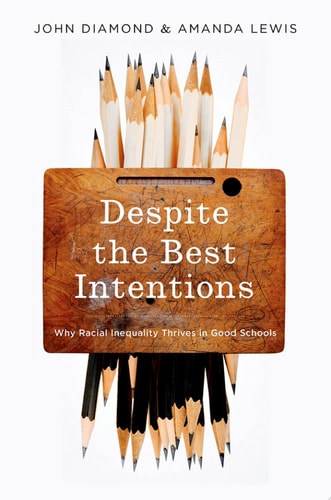
Despite the Best Intentions
0
0
As an Amazon Associate and affiliate partner, Menrva Books earns from qualifying purchases. Learn more
Author Description
On The Surface, Riverview High School Looks Like The Post-racial Ideal. Serving An Enviably Affluent, Diverse, And Liberal District, The School Is Well-funded, Its Teachers Are Well-trained, And Many Of Its Students Are High Achieving. Yet Riverview Has Not Escaped The Same Unrelenting Question That Plagues Schools Throughout America: Why Is It That Even When All Of The Circumstances Seem Right, Black And Latino Students Continue To Lag Behind Their Peers? Through Five Years' Worth Of Interviews And Data-gathering At Riverview, John Diamond And Amanda Lewis Have Created A Rich And Disturbing Portrait Of The Achievement Gap That Persists More Than Fifty Years After The Formal Dismantling Of Segregation. As Students Progress From Elementary School To Middle School To High School, Their Level Of Academic Achievement Increasingly Tracks Along Racial Lines, With White And Asian Students Maintaining Higher Gpas And Standardized Testing Scores, Taking More Advanced Classes, And Attaining Better College Admission Results Than Their Black And Latino Counterparts. Most Research To Date Has Focused On The Role Of Poverty, Family Stability, And Other External Influences In Explaining Poor Performance At School, Especially In Urban Contexts. Diamond And Lewis Instead Situate Their Research In A Suburban School, And Look At What Factors Within The School Itself Could Be Causing The Disparity. Most Crucially, They Challenge Many Common Explanations Of The 'racial Achievement Gap,' Exploring What Race Actually Means In This Situation, And Why It Matters. An In-depth Study With Far-reaching Consequences, Despite The Best Intentions Revolutionizes Our Understanding Of Both The Knotty Problem Of Academic Disparities And The Larger Question Of The Color Line In American Society.
Menrva's Summary
THE THESIS
This book investigates the persistent racial achievement gap within a high-performing, affluent suburban school district to determine how internal institutional factors contribute to academic disparities. Authors Amanda E. Lewis and John B. Diamond, both established scholars in sociology and education, utilize five years of ethnographic research and quantitative data to challenge conventional narratives that attribute academic failure solely to external socioeconomic factors. By focusing on a school that appears to be a post-racial ideal, they argue that institutional practices and racial dynamics within the school environment play a critical role in shaping student outcomes.
THE SCOPE MAP
What You Will Find
- Five years of longitudinal ethnographic research and data collection within a suburban school district.
- Analysis of tracking, course placement, and standardized testing outcomes across racial lines.
- Qualitative evidence derived from extensive interviews with students, teachers, and administrators.
- A critical examination of how institutional culture and racial perceptions influence academic performance.
THE AUTHORITY PERSPECTIVE
Experts in the field of education policy cite this work as a significant contribution to the study of systemic inequality in suburban settings. Readers frequently note the academic density of the prose and the depth of the authors' sociological analysis.
Page Count:
272
Publication Date:
2015-01-01
Publisher:
Oxford University Press
ISBN-10:
0199711534
ISBN-13:
9780199711536
Race Relations
Public Policy
Sociology
Social Science
Education
Community Tags
Similar Books