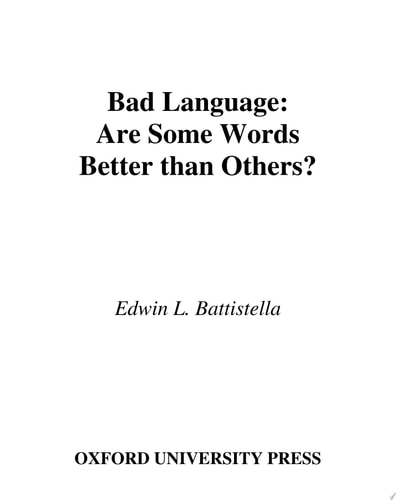
Bad Language: Are Some Words Better than Others?
0
0
As an Amazon Associate and affiliate partner, Menrva Books earns from qualifying purchases. Learn more
Author Description
Is Today's Language At An All-time Low? Are Pronunciations Like Cawfee And Chawklit Bad English? Is Slang Like My Bad Or Hook Up Improper? Is It Incorrect To Mix English And Spanish, As In Yo Quiero Taco Bell? Can You Write Who Do You Trust? Rather Than Whom Do You Trust? Linguist Edwin Battistella Takes A Hard Look At Traditional Notions Of Bad Language, Arguing That They Are Often Based In Sterile Conventionality. Examining Grammar And Style, Cursing, Slang, And Political Correctness, Regional And Ethnic Dialects, And Foreign Accents And Language Mixing, Battistella Discusses The Strong Feelings Evoked By Language Variation, From Objections To The Pronunciation Nu-cu-lar To Complaints About Bilingual Education. He Explains The Natural Desire For Uniformity In Writing And Speaking And Traces The Association Of Mainstream Norms To Ideas About Refinement, Intelligence, Education, Character, National Unity And Political Values. Battistella Argues That None Of These Qualities Is Inherently Connected To Language. It Is Tempting But Wrong, Battistella Argues, To Think Of Slang, Dialects And Nonstandard Grammar As Simply Breaking The Rules Of Good English. Instead, We Should View Language As Made Up Of Alternative Forms Of Orderliness Adopted By Speakers Depending On Their Purpose. Thus We Can Study The Structure And Context Of Nonstandard Language In Order To Illuminate And Enrich Traditional Forms Of Language, And Make Policy Decisions Based On An Informed Engagement. Re-examining Longstanding And Heated Debates, Bad Language Will Appeal To A Wide Spectrum Of Readers Engaged And Interested In The Debate Over What Constitutes Proper Language.
Menrva's Summary
THE THESIS
This book investigates whether specific linguistic variations, such as slang, regional dialects, and nonstandard grammar, are inherently inferior or merely alternative forms of orderliness. Linguist Edwin L. Battistella examines the cultural and social biases that underpin traditional notions of 'bad language.' By analyzing the intersection of grammar, political correctness, and national identity, he argues that the perceived decline in language quality is often a reflection of social anxiety rather than an objective degradation of communication. The work challenges the reader to decouple linguistic norms from assumptions about intelligence, character, and refinement.
THE SCOPE MAP
What You Will Find
- Analysis of linguistic phenomena including slang, regional dialects, and foreign accents.
- Examination of the social and political implications of language mixing and bilingualism.
- Discussion of the historical association between standard English and concepts of national unity.
- A framework for evaluating language use based on context and purpose rather than rigid adherence to traditional rules.
THE AUTHORITY PERSPECTIVE
Experts in linguistics and sociolinguistics frequently cite this work as a balanced, accessible entry point for understanding the complexities of language variation. Readers note that the text successfully demystifies common linguistic anxieties by providing a clear, evidence-based perspective on how language evolves.
Page Count:
240
Publication Date:
2005-01-01
Publisher:
Oxford University Press
ISBN-10:
0199721416
ISBN-13:
9780199721412
Non-Fiction
Education
Categories
Sociology
Kindle eBooks
Social Aspects
Language
Reference
Word Lists
Linguistics
Kindle Store
Slang
Words Language & Grammar
Community Tags
Similar Books



![Chinese reflections: Americans teaching in the People's [sic] Republic](https://storage.googleapis.com/menrva_img_storage/covers/9780030047923.jpg)