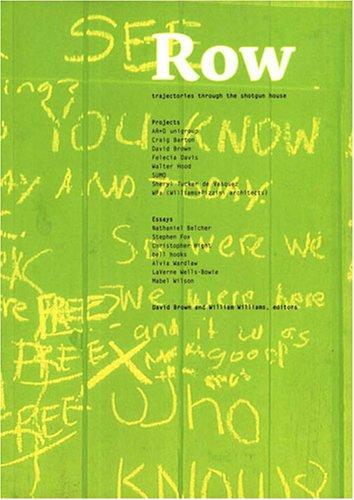
Row
0
0
As an Amazon Associate and affiliate partner, Menrva Books earns from qualifying purchases. Learn more
Author Description
The copious presence of the shotgun house in Third, Fourth, and Fifth Wards, historically African-American neighborhoods directly adjacent to downtown Houston, has provided a basis for work that re-evaluates this house form. In a series of paintings in the 1980s, Houston artist John Biggers identified the shotgun house as a community enabler. Project Row Houses demonstrates this capability through its community revitalization effort, which consists of artist's installations, child after-school care and its Young Mothers Residential Program, all in a cluster of twenty-two row houses. The 15th round of installations in the eight Artist's Houses at Project Row Houses offered a unique opportunity for further study of the shotgun house. The architects and designers invited to develop installations could explore its ability to enable community as well as other characteristics and qualities by working directly within a shotgun house variation. [This book] documents the installations and the presentations from a symposium that preceded their opening. The collected work, which builds on the work of Biggers and Project Row Houses, assesses the historical and cultural significance of the shotgun house, and its material, organizational, and spatial properties, while revealing that the shotgun house has continued relevance as an informant of contemporary architecture and urbanism
Menrva's Summary
THE THESIS
This book investigates the historical and cultural significance of the shotgun house and its continued relevance in contemporary architecture and urbanism. The work documents artist installations and symposium presentations focused on Project Row Houses, a community revitalization effort in Houston's Third, Fourth, and Fifth Wards. It builds upon the legacy of artist John Biggers, who identified the shotgun house as a community enabler, by exploring its material, organizational, and spatial properties through the lens of modern architectural and design interventions. The book assesses how this specific house form continues to inform contemporary architectural and urban design practices.
THE SCOPE MAP
- Documentation of artist installations within the eight Artist's Houses at Project Row Houses.
- Presentations from a symposium preceding the installations.
- Analysis of the shotgun house as a community enabler, building on John Biggers' work.
- Exploration of the material, organizational, and spatial properties of the shotgun house.
- Assessment of the historical and cultural significance of the shotgun house.
- Discussion of the shotgun house's ongoing relevance to contemporary architecture and urbanism.
- Focus on Project Row Houses as a case study in community revitalization through art and housing programs.
THE AUTHORITY PERSPECTIVE
This book is presented as an academic and artistic exploration of a specific architectural form and its role in community development. The content, derived from artist installations and scholarly symposiums, suggests a focus on critical analysis and documentation of architectural and urban design principles. The work appears intended for an audience interested in architectural history, urban planning, and the intersection of art with social revitalization.
Page Count:
211
Publication Date:
2004-01-01
ISBN-10:
188523208X
ISBN-13:
9781885232083
Architecture
Non-Fiction
Urbanism
Community Development
Community Tags
Similar Books