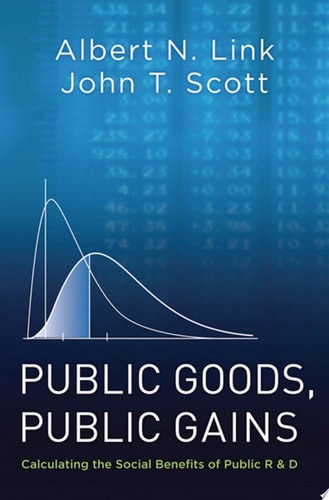
Public Goods, Public Gains: Calculating the Social Benefits of Public R&D
0
0
As an Amazon Associate and affiliate partner, Menrva Books earns from qualifying purchases. Learn more
Author Description
In Public Goods, Public Gains, Link and Scott discuss the systematic application of alternative evaluation methods to estimate the social benefits of publicly financed research and development (R&D). The authors argue that economic theory should be the guiding criterion for any method of program evaluation because it focuses attention on the value and the opportunity costs of the program. The evaluation methods discussed and illustrated are both economics and, for comparison, non-economics based.The book is motivated by four foundation chapters that discuss government's role in innovation from the perspective of economic theory, review public accountability issues from both a constitutional and an historical perspective, overview systematic approaches to program evaluation, and describe the evaluation metrics typically used. Four case studies illustrate the four alternative evaluation approaches discussed. These case studies are for the U.S. Advanced Technology Program's intramural research awards program, the U.S. National Institute of Standards and Technology's research on wavelength references for optical fiber communications, the U.S. Malcolm Baldrige National Quality Award, and the Advanced Technology Program's focused program on the integration of manufacturing applications.
Menrva's Summary
THE THESIS
This book investigates how economic theory can serve as the primary criterion for evaluating the social benefits and opportunity costs of publicly financed research and development programs. Albert N. Link and John T. Scott utilize their expertise in economics to bridge the gap between theoretical frameworks and practical program assessment. By contrasting economic-based evaluation methods with non-economic alternatives, the authors provide a rigorous structure for determining the efficacy of government-funded innovation initiatives. The text establishes a clear methodology for policymakers to justify public expenditure through systematic analysis.
THE SCOPE MAP
What You Will Find
- Theoretical foundations regarding the government's role in fostering innovation.
- A comparative analysis of economic versus non-economic evaluation metrics.
- Historical and constitutional perspectives on public accountability in research funding.
- Four detailed case studies covering the Advanced Technology Program and the Malcolm Baldrige National Quality Award.
THE AUTHORITY PERSPECTIVE
Experts in public policy and economics recognize this work as a structured guide for applying quantitative evaluation methods to government R&D. Readers frequently note the technical density of the prose, which serves as a foundational resource for professionals tasked with measuring the societal impact of public investments.
Page Count:
176
Publication Date:
2011-01-27
Publisher:
Oxford University Press
ISBN-10:
0199729689
ISBN-13:
9780199729685
Business
Economics
Cost effectiveness
Innovation
Public goods
Research Industrial
Public Policy
Community Tags
Similar Books