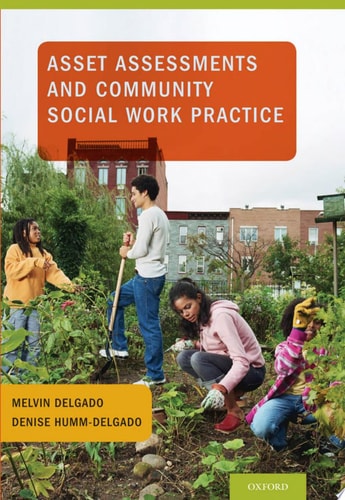
Asset Assessments and Community Social Work Practice
0
0
As an Amazon Associate and affiliate partner, Menrva Books earns from qualifying purchases. Learn more
Author Description
The role and importance of assessment in development of health and social services are well accepted in the field, and represent the fundamental building blocks for the creation of any form of social intervention. Need assessments are, without question, the most common form of assessment in these fields. They typically, however, result in a rather narrow view of a community that stresses disease risk profiles and lists of various social problem categories. Nevertheless, unlike needs assessments, asset assessments bring a range of factors and considerations to the creation of an intervention that are guided by participatory democratic principles and processes. Although need assessments can also be guided by participatory principles, they generally are professionally-driven and do not stress capacity enhancement in the process. Asset assessments' emphasis on participatory democracy sufficiently distance themselves from their needs counterpart through the use of values, language used to communicate, and how research methods get conceptualized and carried out. Community asset assessments can be viewed as a goal; a strategy; a set of guiding principles; a method; and a process. These different perspectives make a consensus definition of a capital difficult to arrive at in both scholarly and practice realms. Consequently, it is best to view asset assessments from an evolutionary point of view in order to appreciate the variety of perspectives, tensions, and potential for achieving positive social change. In essence asset assessments are both an instrument of discovery as well as an intervention to achieve community change.
Menrva's Summary
THE THESIS
This book investigates how shifting the focus of social service planning from deficit-based needs assessments to asset-based assessments can foster more effective and democratic community interventions. Authors Melvin Delgado and Denise Humm-Delgado, both established scholars in social work and community practice, argue that traditional needs-based models often pathologize communities by focusing exclusively on risks and problems. They propose a framework that prioritizes capacity enhancement, participatory democratic principles, and the discovery of existing community strengths to drive sustainable social change.
THE SCOPE MAP
What You Will Find
- A comparative analysis between traditional needs-based assessments and asset-based community development models.
- Methodological frameworks for conceptualizing and executing community asset mapping.
- Discussion of the role of participatory democratic values in social service research.
- Strategies for utilizing asset assessment as both a diagnostic tool and a direct intervention for social change.
THE AUTHORITY PERSPECTIVE
Experts in the field of social work identify this text as a critical resource for practitioners seeking to move beyond deficit-oriented service models. Readers frequently note the clarity with which the authors bridge the gap between theoretical research methods and practical community engagement strategies.
Page Count:
297
Publication Date:
2013-01-18
Publisher:
Oxford University Press
ISBN-10:
0199735840
ISBN-13:
9780199735846
Social Work
Sociology
Public Health
Community Development
Research Methods
Social service
Community Tags
Similar Books