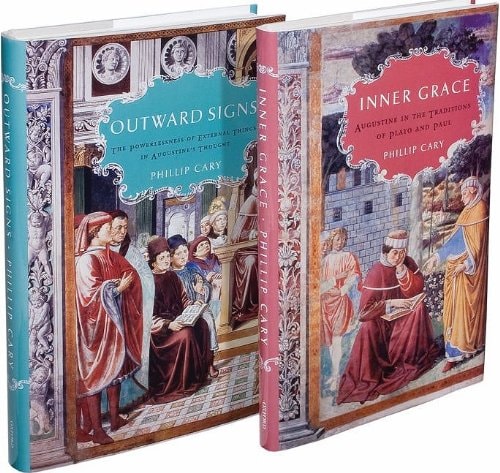
The Augustine Set: Consisting of Inner Grace: Augustine in the Traditions of Plato and Paul and Outward Signs: The Powerlessness of External Things in Augustine's Thought
0
0
As an Amazon Associate and affiliate partner, Menrva Books earns from qualifying purchases. Learn more
Author Description
Cary traces the development of Augustine's epochal doctrine of grace, arguing that it does not represent a rejection of Platonism in favor of a more purely Christian point of view null a turning from Plato to Paul, as it is often portrayed. Instead, Augustine reads Paul and other Biblical texts in light of his Christian Platonist inwardness, producing a new concept of grace as an essentially inward gift. For Augustine, grace is needed first of all to heal the mind so it may see God, but then also to help the will turn away from lower goods to love God as its eternal Good. Eventually, over the course of Augustine's career, the scope of the soul's need for grace expands outward to include not only the inner vision of the intellect and the power of love but even the initial gift of faith. At every stage, Augustine insists that divine grace does not compromise or coerce the human will but frees, heals, and helps it, precisely because grace is not an external force but an inner gift of delight leading to true happiness. As his polemic against the Pelagians develops, however, he does attribute more to grace and less to the power of free will. In the end, it is God's choice which makes the ultimate difference between the saved and the damned, and we cannot know why he chooses to save one person and not another. From this Augustinian doctrine of divine choice or election stem the characteristic pastoral problems of predestination, especially in Protestantism. A more external, indeed Jewish, doctrine of election would be more Biblical, Cary suggests, and would result in a less anxious experience of grace. Bringing together for the first time these two seminal works, this set breaks new ground in the study of Augustine's theology of grace and sacraments.
Menrva's Summary
THE THESIS
This work investigates whether Augustine's doctrine of grace represents a departure from Platonism toward Pauline theology or a synthesis of the two. Phillip Cary, a scholar of historical theology, examines Augustine's writings to argue that the theologian consistently interpreted Biblical texts through a framework of Christian Platonist inwardness. By analyzing the evolution of Augustine's thought, Cary demonstrates how the concept of grace shifted from an internal healing of the intellect to a broader doctrine of divine election that eventually influenced Protestant pastoral theology.
THE SCOPE MAP
What You Will Find
- A detailed analysis of Augustine's intellectual development regarding grace and free will.
- A comparative study of Platonic influence versus Pauline interpretation in early Christian thought.
- Examination of the polemic against Pelagianism and its impact on the doctrine of predestination.
- A critical assessment of the pastoral implications of Augustinian election compared to alternative Biblical interpretations.
THE AUTHORITY PERSPECTIVE
Scholars and theologians recognize this collection as a significant contribution to the study of Augustinian thought, particularly for its nuanced challenge to traditional narratives regarding his transition from Platonism. Readers frequently note the academic density of the prose, which is best suited for those with a background in patristic studies or historical theology.
Page Count:
0
Publication Date:
2009-11-26
Publisher:
Oxford University Press
ISBN-10:
0199740674
ISBN-13:
9780199740673
Philosophy
History
Christianity
Theology
New Used & Rental Textbooks
Academic
Community Tags
Similar Books