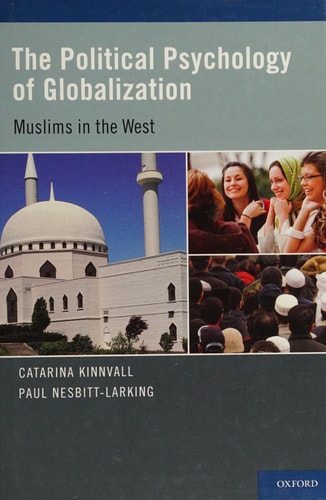
The Political Psychology of Globalization: Muslims in the West
0
0
As an Amazon Associate and affiliate partner, Menrva Books earns from qualifying purchases. Learn more
Author Description
In an increasingly globalized world, there are new economic, strategic, cultural, and political forces at work. The Political Psychology of Globalization: Muslims in the West explores how these shifts and shocks have influenced the way in which Muslim minorities in western countries form their identities as political actors. Catarina Kinnvall and Paul Nesbitt-Larking uncover three identity strategies adopted by Muslims in the West: retreatism, essentialism, and engagement. Six western countries - Canada, Denmark, France, the Netherlands, Sweden, and the United Kingdom - serve as places for exploration of the emergence of these Muslim political identities. These countries are discussed in light of their colonial histories, patterns of immigration, and citizenship regimes.Although retreatism, essentialism, and engagement occur in Muslim citizens of each of the six western nations discussed in this book, the countries that are best able to balance individual and community rights are most successful in promoting the politics of engagement. In contrast, regimes that focus on anti-terrorist legislation and discourses, and support majority political cultures that are exclusionary, also promote retreatism and essentialist identity strategies in both minority and majority communities. The authors discuss the importance of a climate of engagement that is based on recognition, dialogue, deep multiculturalism, a new global and "cosmopolitical" consciousness, and a sense of political identity that transcends national boundaries and regimes.
Menrva's Summary
THE THESIS
This book investigates how the pressures of globalization influence the formation of political identities among Muslim minority populations residing in Western nations. Catarina Kinnvall and Paul Nesbitt-Larking utilize a political psychology framework to analyze the intersection of individual agency and state-level policy. By examining the interplay between national citizenship regimes and minority experiences, the authors argue that inclusive political environments are essential for fostering constructive civic engagement rather than reactionary identity strategies.
THE SCOPE MAP
What You Will Find
- Comparative analysis of six Western nations: Canada, Denmark, France, the Netherlands, Sweden, and the United Kingdom.
- A tripartite model of identity strategies: retreatism, essentialism, and engagement.
- Examination of how colonial histories and immigration patterns shape contemporary political discourse.
- Evaluation of the impact of anti-terrorist legislation on minority integration and social cohesion.
THE AUTHORITY PERSPECTIVE
Experts recognize this work as a significant contribution to the study of political psychology and minority integration in the West. Readers frequently note the academic rigor of the authors' comparative approach and the clarity with which they map complex identity responses to state policies.
Page Count:
240
Publication Date:
2011-07-29
Publisher:
Oxford University Press
ISBN-10:
0199747547
ISBN-13:
9780199747542
International relations
Muslims
Globalization
Identity politics
Muslim Studies
Sociology
Community Tags
Similar Books