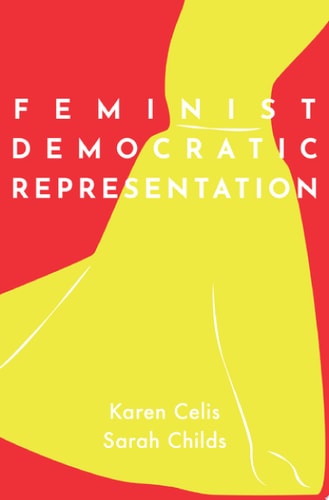
Feminist Democratic Representation
0
0
As an Amazon Associate and affiliate partner, Menrva Books earns from qualifying purchases. Learn more
Author Description
Popular consensus has long been that if "enough women" are present in political institutions they will represent "women's interests." Yet many believe that differences among women--women disagreeing about what is in "their interest"--fatally undermine both the principle and the practice of women's group representation. In this book, Karen Celis and Sarah Childs redress women's poverty of political representation with a new feminist account of democratic representation. Rather than giving up on women's group representation, Celis and Childs re-think and re-design representative institutions, taking women's differences--both ideological and intersectional--as their starting point.Feminist Democratic Representation considers a broad spectrum of contemporary problematics--abortion, prostitution/sex work, Muslim women's dress, and Marine Le Pen--to discuss women's under- and misrepresentation and the "good, bad and the ugly" representative. As problem-driven scholars firmly grounded in feminist and democratic empirical and theoretical political science, Celis and Childs imagine what good representation for women in all their diversity could look like--representation as it should be. To realize this ideal in today's established representative democracies, they present a second-generation feminist design for parliaments and legislatures, underpinned by a re-thinking of feminist and democratic principles.Celis and Childs conceive of representation as a mélange of dimensions, and they shift the focus in women's group representation from feminist outcome to feminist process. Inclusive, responsive, and egalitarian representation for all women demands a new category of representatives in parliaments: the "affected representatives of women" who are epistemologically and experientially close to differently affected women. Affected representatives passionately advocate within political institutions, and publicly hold elected representatives to account. Feminist processes of representation have wide effects and deepen relationships between women and their democratic institutions. Against the more fashionable tide of post-representative politics, Feminist Democratic Representation argues not simply for more, but significantly better, representation.
Menrva's Summary
THE THESIS
How can democratic institutions effectively represent the diverse and often conflicting interests of women? Karen Celis and Sarah Childs, both established scholars in political science, utilize empirical data and theoretical frameworks to challenge the traditional assumption that mere numerical presence of women in government equates to adequate representation. They argue for a shift from focusing on feminist outcomes to prioritizing feminist processes, proposing a new model of representation that accounts for intersectional and ideological differences among women.
THE SCOPE MAP
What You Will Find
- Analysis of contemporary political issues including abortion, sex work, and religious expression
- A proposed second-generation feminist design for parliamentary and legislative institutions
- The introduction of the 'affected representative' framework
Scope Limits
- The text focuses primarily on established representative democracies rather than authoritarian or non-democratic systems
- It does not provide a comprehensive history of global women's suffrage movements
THE AUTHORITY PERSPECTIVE
Experts in political science and gender studies identify this work as a significant contribution to the discourse on institutional design and democratic accountability. Readers frequently note the academic density of the prose, which is intended for scholars and practitioners interested in the mechanics of political representation.
Page Count:
256
Publication Date:
2020-09-28
Publisher:
Oxford University Press
ISBN-10:
0190087722
ISBN-13:
9780190087722
Sociology
Feminism
Gender Studies
Democratic Theory
Government
Community Tags
Similar Books













Reader Comments
Share Your Thoughts
No comments yet. Be the first to share your thoughts!