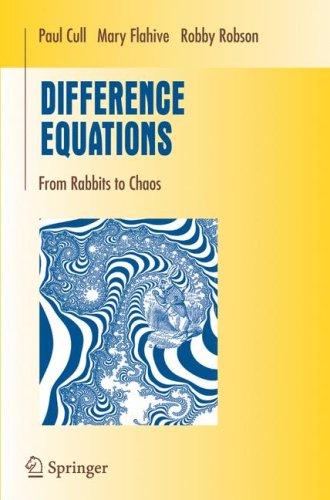
Difference Equations
0
0
As an Amazon Associate and affiliate partner, Menrva Books earns from qualifying purchases. Learn more
Author Description
Difference equations are models of the world around us. From clocks to computers to chromosomes, processing discrete objects in discrete steps is a common theme. Difference equations arise naturally from such discrete descriptions and allow us to pose and answer such questions as: How much? How many? How long? Difference equations are a necessary part of the mathematical repertoire of all modern scientists and engineers. In this new text, designed for sophomores studying mathematics and computer science, the authors cover the basics of difference equations and some of their applications in computing and in population biology. Each chapter leads to techniques that can be applied by hand to small examples or programmed for larger problems. Along the way, the reader will use linear algebra and graph theory, develop formal power series, solve combinatorial problems, visit Perron—Frobenius theory, discuss pseudorandom number generation and integer factorization, and apply the Fast Fourier Transform to multiply polynomials quickly. The book contains many worked examples and over 250 exercises. While these exercises are accessible to students and have been class-tested, they also suggest further problems and possible research topics. Paul Cull is a professor of Computer Science at Oregon State University. Mary Flahive is a professor of Mathematics at Oregon State University. Robby Robson is president of Eduworks, an e-learning consulting firm. None has a rabbit.
Menrva's Summary
THE THESIS
Difference equations serve as fundamental models for understanding systems that operate in discrete steps. The book introduces these equations as essential tools for scientists and engineers, covering their basics and applications in computing and population biology. It aims to equip sophomores in mathematics and computer science with techniques that can be applied manually or through programming, integrating concepts from linear algebra, graph theory, and formal power series.
THE SCOPE MAP
- Fundamentals of difference equations and their applications.
- Integration of linear algebra and graph theory concepts.
- Development of formal power series and combinatorial problem-solving.
- Exploration of Perron-Frobenius theory.
- Discussion of pseudorandom number generation and integer factorization.
- Application of the Fast Fourier Transform for polynomial multiplication.
- Numerous worked examples and over 250 class-tested exercises.
THE AUTHORITY PERSPECTIVE
The book is presented as a text for sophomores in mathematics and computer science, suggesting a pedagogical approach focused on practical application and problem-solving. The inclusion of numerous exercises, many of which have been class-tested, indicates an emphasis on student engagement and the potential for further exploration. The authors' backgrounds as professors in Computer Science and Mathematics at Oregon State University, along with a president of an e-learning firm, suggest a blend of academic rigor and practical relevance in the material.
Page Count:
394
Publication Date:
2005-01-01
ISBN-10:
0387232346
ISBN-13:
9780387232348
Science
Non-Fiction
Mathematics
Computer Science
Discrete Mathematics
Applied Mathematics
Community Tags
Similar Books